Two Police Officers Handcuffed a Young Woman on a Quiet Road—Then They Discovered Who She Really Was
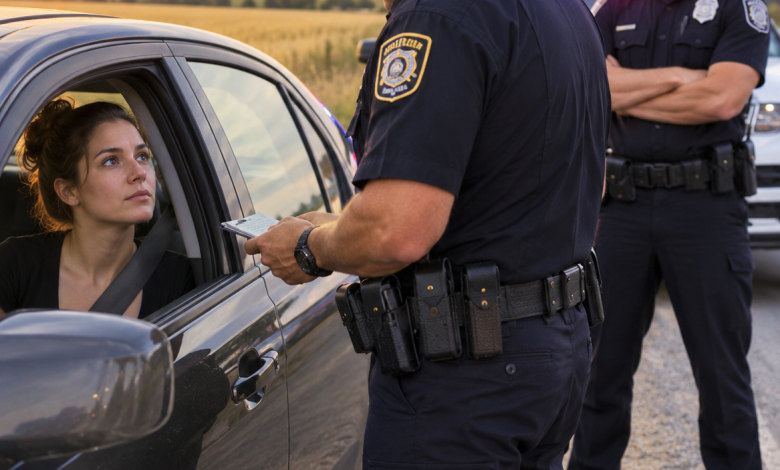
Two Police Officers Handcuffed a Young Woman on a Quiet Road—Then They Discovered Who She Really Was
An Ordinary Drive Home
The evening had begun like countless others.
I was driving home after a long, exhausting meeting that had stretched more than an hour beyond its scheduled end. My shoulders ached, my thoughts were scattered, and all I wanted was to reach my apartment, take a warm shower, and enjoy a little peace.
The windows of my gray hatchback were slightly open. A familiar song played on the radio, and the late-summer breeze carried the smell of dry grass and freshly harvested fields.
It was late August. The countryside glowed beneath the setting sun, with golden fields extending toward the horizon.
Traffic was light. I had passed only a handful of vehicles during the previous several miles.
I was driving at exactly the posted speed limit.
That was a habit I had developed over the years. My profession had taught me how quickly an ordinary situation could become complicated, particularly when someone in authority decided to misuse their position.
But that evening, I wasn’t thinking about work.
I was thinking about going home.
Then flashing red and blue lights appeared in my rearview mirror.
The Unexpected Traffic Stop
My heart immediately began beating faster.
Even when you know you have done nothing wrong, the sight of a police vehicle behind you can produce an instinctive sense of unease.
I reduced my speed, activated my turn signal, and pulled onto the gravel shoulder.
After stopping, I lowered my window and placed both hands where the approaching officers could clearly see them.
I had given that same advice to many people over the years.
Stay calm. Keep your hands visible. Avoid sudden movements.
Two officers stepped out of the patrol car.
The first was a broad-shouldered man with a shaved head and an expression that suggested he had little patience for questions. The second was younger, slimmer, and noticeably more relaxed.
The older officer approached my window while his partner remained near the rear of my vehicle.
“Documents,” the older man demanded.
There was no greeting.
No introduction.
Not even a polite explanation for the stop.
I slowly retrieved my driver’s license, registration, and insurance information.
“Good evening, officer,” I said. “May I ask why I’ve been stopped?”
He ignored the question.
Instead, he examined my documents, turned them over several times, and walked around my car.
He inspected the tires, the license plate, and the windshield.
I waited patiently.
When he returned, I asked again.
“Was I speeding? Is there a problem with my vehicle?”
“Routine inspection,” he answered.
“What kind of inspection?”
His expression hardened.
I continued speaking in an even tone.
“I would also appreciate your name and badge number.”
That was when the atmosphere changed.
When a Simple Question Became a Confrontation
The younger officer walked toward us, wearing an amused expression.
“You’ve got a lot of questions,” he remarked. “Why don’t you just cooperate?”
“I am cooperating,” I replied. “I’ve provided my documents. I’m simply asking why I was stopped.”
The older officer stared at me.
Then, without warning, he tossed my documents onto the roof of my car.
“Get out,” he ordered.
“Can you explain why?”
“I said get out of the vehicle.”
His voice had become sharper.
I recognized the pattern immediately.
I had encountered similar behavior in complaints, interviews, and recordings throughout my professional career.
A person asks a reasonable question. An officer interprets that question as disrespect. The situation escalates because someone believes authority should never be challenged.
I reached toward the phone resting on my passenger seat.
I intended to record what was happening.
Before I could unlock it, the younger officer pulled open my door and seized my wrist.
“Leave the phone alone.”
“Please don’t grab me,” I said firmly.
“You’re making this difficult,” he replied.
I looked directly at him.
“I’m asking you to respect my rights.”
Those words only seemed to make matters worse.
Handcuffed Beside My Own Car
The older officer moved suddenly.
He grabbed my upper arm, pulled me from the driver’s seat, and pushed me against the side of my car.
My cheek pressed against the cool metal.
The younger officer forced my hands behind my back.
A moment later, I heard the metallic click of handcuffs.
They were painfully tight.
My shoulder hurt, and I could feel the pressure around my wrists.
I did not struggle.
I did not shout.
Instead, I tried to remain composed.
The older officer leaned closer.
“Maybe a few hours at the station will teach you how to behave,” he said.
I turned my head slightly.
“Are you certain you want to continue with this?”
He laughed.
“Is that supposed to be a threat?”
“No,” I answered. “I’m asking you to think carefully about what you’re doing.”
I reminded him that I had requested an explanation, provided my documents, and made no attempt to resist.
He dismissed everything I said.
“We’ll deal with it at the station.”
The sun was almost gone.
The road was quiet, and the fields around us were turning dark.
I knew I had one opportunity to change the direction of the encounter.
The Identification Card in My Pocket
“Before you take me anywhere,” I said, “there’s something in the right pocket of my shorts. I can’t reach it with my hands behind my back.”
The officers exchanged glances.
The younger one laughed.
“What is it? Money?”
“Just take a look,” I replied.
The older officer hesitated before reaching into my pocket.
He removed a small black leather identification case.
At first, he opened it casually.
Then his entire expression changed.
He stared at the identification card.
He read the name.
Then the rank.
Then the department.
His face lost its color.
The younger officer noticed immediately.
“What is it?”
Without answering, the older officer handed him the case.
The younger man’s confidence disappeared as he read it.
The identification belonged to me.
Victoria Sokolova. Senior Inspector. Directorate of Internal Affairs.
My department investigated allegations of police misconduct, corruption, abuse of authority, and other violations committed by law enforcement personnel.
I was not conducting an undercover operation.
I had not been assigned to observe these officers.
I was simply an off-duty investigator driving home in my personal vehicle.
But now they understood who they had detained.
And what their actions might mean.
“Why Didn’t You Tell Us?”
The younger officer looked at me with visible alarm.
“Why didn’t you tell us who you were?”
I held his gaze.
“Because I wanted to know how you treat people who don’t carry this identification.”
Neither man answered.
For the first time since the traffic stop began, they seemed uncertain of what to do.
The older officer hurried to remove the handcuffs.
His hands shook as he searched for the key.
When the cuffs finally came off, I noticed a small cut on my wrist.
Blood had begun to appear where the metal had pressed against my skin.
“This was a misunderstanding,” the older officer said quickly.
“You weren’t cooperating. We didn’t realize—”
I interrupted him.
“You didn’t realize I worked for Internal Affairs?”
He fell silent.
“That shouldn’t have mattered,” I continued. “I was entitled to respectful and lawful treatment before you knew my job.”
The younger officer tried another approach.
“Maybe we can forget the whole thing.”
I raised my injured wrist.
“Does this look like nothing happened?”
He looked away.
The Evidence They Didn’t Know Existed
There was something else the officers did not know.
My vehicle had a dashboard camera.
It had recorded the traffic stop from the beginning.
The flashing lights.
The demand for documents.
The unanswered questions.
The papers thrown onto my car.
The confrontation.
The physical restraint.
And the handcuffs.
The camera had captured both video and audio, and the recording had been automatically backed up.
The officers could apologize.
They could change their explanation.
They could even deny parts of what happened.
But the recording would remain.
I retrieved my documents from the roof of the car and returned to the driver’s seat.
My hands were trembling.
My wrist hurt.
My shoulder was sore.
Despite the calm voice I had maintained during the encounter, I was shaken.
I took a moment to steady myself.
Then I called my supervisor.
Why This Encounter Was Personal
My decision to work in Internal Affairs had been shaped by something that happened when I was twelve years old.
My father was a secondary-school physics teacher.
He was a quiet, thoughtful man who loved books, mathematics, and old sweaters with patches on the elbows.
One evening, two traffic officers stopped him while he was driving home.
They demanded money.
My father refused.
He had not committed a violation, and he believed that politely explaining himself would resolve the situation.
Instead, the officers dragged him from his car and assaulted him.
He returned home with serious injuries.
My mother took him to the hospital, and I accompanied them.
I remember sitting in the back seat, holding his damaged glasses.
One lens had cracked.
My father later filed an official complaint.
He described the officers, the location, and everything that had happened.
Weeks passed.
Eventually, he received a short letter stating that the investigation had found no wrongdoing.
There was no meaningful explanation.
No accountability.
He put the letter away and rarely spoke about it again.
But something changed.
For the rest of his life, he avoided the road where the incident occurred.
He preferred a twenty-minute detour to the possibility of encountering those officers again.
I never forgot that.
As a child, I promised myself that one day I would work somewhere complaints like his were taken seriously.
Years later, I became an investigator.
And now I was sitting beside a country road, with bruised wrists, remembering exactly why.
The Police Chief Arrives
Approximately fifteen minutes after my phone call, another official vehicle pulled onto the shoulder.
A senior officer stepped out.
It was Colonel Gennady Markov, the district police chief.
Two Internal Affairs investigators accompanied him: Pavel Grishin and Lena Arkhipova, both colleagues of mine.
My supervisor, Major Irina Kovaleva, had contacted them.
Colonel Markov approached my car first.
“Inspector Sokolova, are you injured?”
“Nothing serious,” I answered.
Then I showed him the recording.
He watched without speaking.
As the video continued, his expression grew increasingly severe.
He saw how the officers had behaved.
He heard their words.
He watched them remove me from the vehicle and restrain me.
When the recording ended, he returned my phone.
Then he approached the two patrol officers.
“Hand over your badges and service weapons,” he ordered.
The older officer attempted to explain.
“Sir, there has been a misunderstanding—”
“You’ll have an opportunity to provide your explanation during the formal review.”
The officers complied.
Neither looked confident anymore.
A Hospital Visit and a Difficult Night
Lena examined my wrist.
The skin was broken, and bruising had begun to develop.
“We need photographs,” she said. “And you should be examined by a doctor.”
I agreed.
Pavel drove me to the hospital in my car while Lena followed.
A doctor documented the injuries to my wrist, shoulder, and cheek.
He asked how they had occurred.
I explained.
He paused.
“Police officers did this?”
“Yes.”
He carefully recorded my statement.
Then he mentioned that his brother had once experienced a similar incident but had been too discouraged to report it.
His words stayed with me.
I returned home after midnight.
The shower I had wanted so badly no longer mattered.
I sat on my bed for a long time before calling my mother.
She answered sleepily.
“Victoria? Is everything all right?”
“I just wanted to hear your voice.”
She immediately sensed that something was wrong.
“Were you hurt?”
“A little.”
There was a pause.
“Was it the police?”
I closed my eyes.
“Yes, Mama.”
She was silent for a moment.
Then she said something I will always remember.
“Your father would be furious about what happened to you. But he would also be proud of you.”
After we ended the call, I sat quietly in the darkness.
The Formal Investigation Begins
The following morning, I submitted an official report.
I included the recording, photographs, medical documentation, and a detailed account of the encounter.
Writing it was harder than I expected.
I had prepared hundreds of reports during my career.
This was the first time I had to describe my own fear, pain, and vulnerability.
Several times, I found myself wanting to remove details that made me appear less composed.
The trembling in my voice.
The fear I felt when the handcuffs tightened.
The moment I nearly cried.
But accuracy mattered more than pride.
I included everything.
A few days later, Major Kovaleva called me into her office.
She had ordered a review of earlier complaints involving the older officer.
His name was Sergeant Igor Volkov.
He had served for twelve years.
His younger partner was Officer Denis Sadov.
Major Kovaleva placed three old complaint files on her desk.
“None of these cases was properly pursued,” she told me.
I opened the first folder.
Three Complaints That Had Been Ignored
The first complaint came from a delivery driver named Ruslan Tagirov.
Four years earlier, he reported being stopped, searched without justification, and deprived of money by an officer matching Volkov’s description.
His complaint had been closed.
The second came from a seventy-one-year-old woman named Valentina Petrovna Zueva.
She alleged that an officer had threatened to impound her car unless she paid him money.
The amount represented her monthly pension.
Her complaint had also been dismissed.
The third came from a teenager named Artyom Belov.
He reported being handcuffed and left beside a road in the rain for hours after a minor traffic-related encounter.
He had apologized to the officer, but his complaint was rejected as unreliable.
Each file contained a familiar description.
A large officer.
A shaved head.
An aggressive manner.
And an official conclusion that there was insufficient evidence.
I closed the folders.
“Three people tried to report him,” I said.
Major Kovaleva nodded.
“And none of them was heard.”
I thought about my father.
His complaint had ended in much the same way.
Meeting the People Behind the Files
I asked permission to contact the three complainants.
My supervisor agreed, provided Lena accompanied me and I did not interfere with the investigation into my own encounter.
We visited Valentina first.
She lived in a modest apartment in an older building.
When I introduced myself, she appeared suspicious.
But when I mentioned her complaint, her expression changed.
“Nobody ever contacted me again,” she said.
“I know. I’m sorry. Your complaint is being reviewed again.”
She invited us inside.
Over tea, she explained how losing her pension had forced her to choose between groceries and medication.
“I filed the complaint because what happened was wrong,” she said. “I thought someone should know.”
“I read every word,” I told her.
Her eyes filled with tears.
“Thank you.”
The next person was Ruslan.
He was angry.
“Four years,” he said. “Why should I believe anyone cares now?”
“You have every reason to be frustrated,” I answered. “You should have received a proper investigation years ago.”
He explained how the incident had affected his job and reputation.
Eventually, he agreed to cooperate.
Then we visited Artyom.
He was eighteen now.
His mother described how frightened he had been after being left handcuffed in the rain.
Artyom sat quietly until I told him that his original complaint had been reviewed.
“They said I had an attitude,” he whispered.
“I saw that.”
“But I didn’t. I apologized.”
“I believe you,” I said.
He looked up.
For a moment, he said nothing.
Then he lowered his head and began to cry.
His mother placed a hand on his shoulder.
I understood that hearing those three words mattered to him.
Perhaps more than anything else we could have said.
The Review Board Hearing
The disciplinary review took place over two sessions.
I testified and presented the recording.
The board examined the traffic stop carefully.
One senior officer asked why I had not identified myself as an Internal Affairs investigator at the beginning.
I explained that I had considered doing so.
But I also knew what would probably have happened.
The officers might have immediately changed their behavior.
They might have apologized and allowed me to leave.
And then the next ordinary driver could have experienced the same treatment.
“I didn’t create the situation,” I told the board. “I asked ordinary questions and complied with reasonable instructions. Their decisions were their own.”
One board member questioned whether my conduct had been intended to provoke the officers.
I disagreed.
“Respectfully asking for an officer’s identity and the reason for a stop should not be considered provocation.”
The room became quiet.
Then the recording was played.
Two Officers, Two Different Explanations
Sergeant Volkov maintained that I had been uncooperative.
He claimed my movement toward the passenger seat had made him concerned for his safety.
He insisted that physical restraint had been necessary.
But the recording showed the encounter in detail.
When asked to identify the exact moment he believed he was threatened, he struggled to provide an answer.
The board also reviewed the previous complaints.
Volkov eventually stopped arguing.
Officer Sadov gave a different account.
He admitted that the stop had lacked a legitimate basis.
He acknowledged that he knew the situation was escalating improperly.
When asked why he had not intervened, he said he had been afraid to challenge his senior partner.
He had been taught that officers should always support one another.
“I thought I was supposed to back him up,” he said.
Then he looked toward me.
“I should have told him to stop.”
His apology did not erase his actions.
But he accepted responsibility for them.
The board took note.
The Decision
Three weeks later, the disciplinary findings were announced.
Sergeant Igor Volkov was dismissed from the police force.
The findings included unlawful detention, excessive force, abuse of authority, and serious professional misconduct.
The renewed examination of earlier complaints also led to an investigation into allegations of extortion.
The prosecutor’s office opened a criminal case.
Officer Denis Sadov received a different disciplinary outcome.
He was demoted and reassigned to administrative duties.
His record would permanently reflect his failure to intervene during an unlawful detention.
When Major Kovaleva informed me of the decision, I expected to feel relieved.
I did.
But I did not feel victorious.
I felt exhausted.
The process had exposed how many people had been harmed before anyone took meaningful action.
And I could not stop thinking about how different the outcome might have been if I had been an ordinary driver without a recording or professional connections.
The People Who Had Waited for Justice
In the weeks that followed, other officers approached me privately.
Some admitted that Volkov’s behavior had been widely known.
Others said they had stopped reporting misconduct because they feared retaliation or believed nothing would change.
One officer told me that the road where Volkov worked had acquired a nickname among colleagues.
They called it his “tollbooth.”
That conversation troubled me deeply.
If so many people had suspected wrongdoing, why had it continued for years?
The answer was uncomfortable.
Some people were afraid.
Others had become indifferent.
And the system had repeatedly failed those who tried to speak up.
I realized that accountability could not depend on a victim’s profession, influence, or access to evidence.
It had to exist for everyone.
Three Messages I Will Never Forget
Several weeks later, three messages arrived.
The first was from Valentina.
She wrote that arrangements had been made to return the money taken from her.
She had used part of it to prepare a family meal.
She told her grandchildren about the investigation.
Her granddaughter now wanted to become a police inspector.
The second message came from Ruslan.
His former employer had finally apologized for doubting him.
It had taken years, but someone had acknowledged that he had told the truth.
The third message was from Artyom.
His letter surprised me most.
He had applied to the police academy.
And he had been accepted.
His mother had questioned his decision.
After everything he had experienced, why would he want to become a police officer?
He explained that the experience had shown him exactly what kind of officer he did not want to be.
Then he wrote about our conversation.
He remembered me saying, “I believe you.”
He wanted to become the kind of officer who listened carefully, treated people fairly, and took complaints seriously.
I read his letter several times.
Then I placed it in my desk drawer beside a photograph of my father.
Returning to the Same Road
About a month after the traffic stop, I drove along that road again.
I was traveling to another meeting.
The countryside looked different.
The tall wheat had been harvested, leaving fields of short golden stalks beneath the autumn sky.
As I approached the old bus shelter, I instinctively slowed down.
I recognized the gravel shoulder.
The place where my documents had been thrown onto my car.
The place where I had been handcuffed.
The place where two officers had suddenly changed their behavior after discovering my identity.
There was nothing unusual about it now.
Just an ordinary road beside ordinary fields.
I thought about my father.
After his experience, he had avoided the road where he was assaulted for the rest of his life.
He had allowed fear to change his route home.
I understood why.
But I also knew that I did not want to spend the rest of my life avoiding this place.
So I continued driving.
The windows were open.
A familiar song came on the radio, one my father used to whistle while marking his students’ papers.
I smiled.
I kept my speed exactly at the legal limit.
And for the first time since that evening, the road ahead no longer felt like the scene of something frightening.
It was simply a road.
A road I had every right to travel.
The Lesson That Stayed With Me
What happened that evening was not important because I happened to work for Internal Affairs.
It was important because of what the officers did before they knew who I was.
A person’s rights should never depend on a job title, a badge, an influential family, or the ability to contact someone powerful.
Respect should not be reserved for people who can cause consequences.
It should be the starting point for every encounter.
I also learned that accountability is rarely as simple as a dramatic moment of recognition.
The identification card changed the officers’ behavior.
But it was the recording, the medical evidence, the investigation, and the willingness of others to speak that established what had happened.
And the people whose complaints had been ignored deserved attention long before my case brought their experiences back into view.
I still think about Valentina, Ruslan, and Artyom.
I think about the years they spent believing nobody had listened.
Most of all, I think about my father.
He never received the acknowledgment he deserved.
But his experience helped shape the person I became.
I cannot undo what happened to him.
I cannot erase every injustice.
What I can do is remember why I chose this profession and continue to insist that every complaint deserves a fair examination.
Because justice should never depend on discovering that the person you mistreated has the power to hold you accountable.
It should depend on doing what is right in the first place.