Waitress Lost Her Job Due To Kindness
This is a work of fiction, inspired by a short story that has been circulating online. The people, restaurant, and events are not a report of a real, confirmed incident.
I went back to thank a waitress for her kindness, and I found out she had lost her job.
The day before, Diane had helped me when I could not pay for dinner with my children. She did not embarrass me. She did not make a show of it. She treated me like a person who had hit a bad hour, not like a problem to be moved out of the booth. I went back the next day with the money, a thank-you, and a plan to leave her a better tip than I could afford the night before. Instead, I learned that the owner had fired her after reviewing the security footage.
What I saw on that screen made me question who had actually done something wrong.

A Dinner I Thought I Could Cover
It had been a thin month. I will not dress that up. My hours at the warehouse had been cut, the rent was due in a week, and I had been doing the quiet kind of math that parents do in the grocery aisle: which things can wait, which things cannot, and how to make a Tuesday night feel like something other than a retreat.
Leo, who is eight, had spent the afternoon building a cardboard spaceship on the living-room floor. Maya, who is six, had taped a paper star to the side of it and declared herself the captain. By early evening they were hungry, restless, and looking at me with the particular hope children have when they can tell you have been tired for a long time.
I checked my wallet twice. I thought I had enough for a simple meal if we were careful. I also thought, wrongly, that the card in the side pocket still had a little room on it.
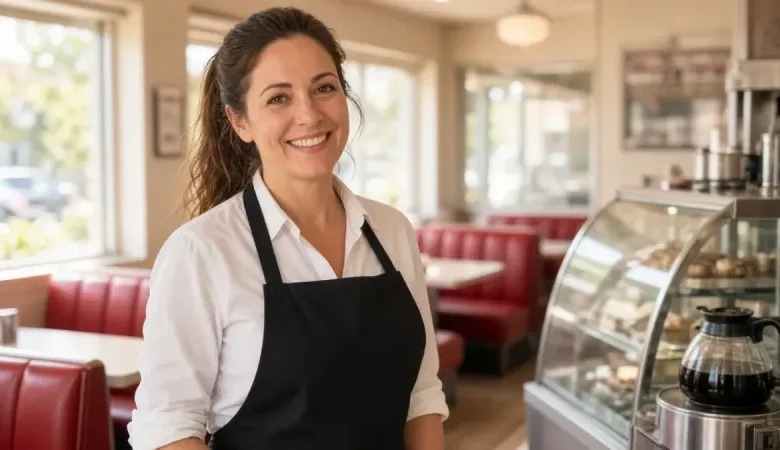
There is a family diner three blocks from our apartment, the kind of place with red vinyl booths, a coffee pot that never seems to empty, and a pastry case that fogs a little when the door opens. We had been there on better weeks, when a pancake breakfast felt ordinary instead of like a small celebration. I told the kids to put on their jackets. Maya zipped hers crooked and did not notice. Leo held the door for her because he had recently decided that holding doors was a serious job.

The bell over the door gave its usual thin ring. The air smelled like toast and coffee. A couple sat at the counter with their coats still on, and a family in the back booth was finishing a plate of fries.
I felt, for a moment, like a person who could still take his children out to eat. That feeling is a kind of warmth, and I did not want to examine it too closely in case it vanished.
We took a booth by the window. Maya knelt on the seat so she could watch the street. Leo opened the menu as if it were a book he had been waiting to finish. I already knew what they would order, but I let them look anyway. Choosing is part of the fun when you do not go out often.
That was when I first noticed Diane, though I did not yet know her name. She was in a white shirt and a black apron, hair pulled back, moving between tables with the unhurried attention of someone who had done this work long enough to make it look easy.
She brought waters before we asked. She crouched a little when she spoke to Maya, which is a small thing and also a kind one. She did not rush the kids through the menu. She suggested the grilled cheese for Maya and the pancakes for Leo, and she asked if I wanted coffee or just water. I said water. I was already counting.
I ordered a sandwich I thought was the cheapest thing I could reasonably eat without looking as if I were not eating. The kids did not notice. They were busy arguing, gently, about whether the spaceship would need a flag.
The Meal That Felt Like a Good Idea
The food came faster than I expected. Maya’s grilled cheese pulled into long strings, and she laughed at that as if it were a trick performed just for her.
Leo cut his pancakes into careful triangles and placed a blueberry on top of each one, a ceremony he had invented last year and had not yet grown out of. I ate slowly, not because I wanted to linger, but because I wanted the hour to last. I asked them about school. Leo told me a long story about a science project involving baking soda. Maya told me her teacher had a new plant, and the plant had a name, and the name was “Leafy,” which she thought was very funny.

Diane refilled the waters. She asked Maya about the star on her jacket, which Maya had forgotten was still taped there from the spaceship. She told Leo that pancakes built like that deserved respect.
She did not hover, and she did not disappear. Good service has a rhythm, and she had it.
I watched the other tables in a loose, idle way. A teenager was doing homework in a corner. An older man was reading a paper and dipping toast into an egg. The diner felt like a place that had held a thousand ordinary evenings, and I wanted ours to be one of them. I even thought, briefly, about leaving a slightly better tip than usual, then remembered the math and felt a familiar tightness in my chest.
When the plates were nearly empty, Maya said she was full and then ate two more fries, which is how Maya is.
Leo asked if we could come back “when it is not a special day,” and I said maybe, which is the word I use when I do not want to say no and cannot honestly say yes.
Diane brought the check in a little folder and told us there was no hurry. I smiled and said we were fine. The kids were drawing on the back of a paper placemat with a stub of crayon Maya had found in her pocket. I opened the folder the way you open something you expect to be manageable.
The Moment I Wanted the Floor to Open
I looked at the total and felt the first small drop in my stomach. It was not outrageous. It was simply more than the cash in my wallet, once I counted it a third time, because I had forgotten tax and had been too optimistic about the card.
I tried the card anyway. The machine took a moment, which is a long time when you are hoping. Then it failed. I tried again, as if the second attempt might find money that the first one had missed. It failed again. The wallet, when I opened it fully, held a few small bills that were not going to be enough, a grocery receipt, and a library card. I sat there with the folder in my hands and felt heat move up my neck.

I have been broke before, but I had not been broke like that in front of my children in a public place. There is a particular shame in it, not because hunger is shameful, and not because a tight month is a moral failure, but because you want your kids to believe you can handle the next ordinary thing.
A diner check is an ordinary thing.
Leo looked up. “Dad? Are we going?”
“In a minute,” I said, and I hated how thin my voice sounded.
I was trying to decide whether to walk to the counter and explain, or to go outside and call my sister, who lived twenty minutes away and had already helped more than I liked to admit, when Diane came back. She must have seen my face, or the way I was holding the wallet, or the way I was not looking at the kids. She did not announce anything. She simply stood beside the table and spoke quietly, as if we were talking about the weather.
“Is everything all right?” she asked.
I tried to make a joke of it and failed. I told her the truth in a low voice: the card had been declined, I had miscounted the cash, and I needed a minute to figure this out.
I could feel Maya watching me, even though she could not have understood every word. Children understand tone long before they understand money.

Diane nodded once, as if this were a problem she had seen and had already decided how to handle. “You can take care of it later,” she said. “Don’t worry about it tonight. Let the kids finish their drawings. I’ll handle the check with my manager so you don’t have to stand at the register.”
I started to protest. I told her I could leave my name, my number, whatever she needed. I told her I would come back in the morning. She said that would be fine, and she smiled at the kids as if nothing in the room had changed.
She even asked Maya whether the spaceship flag should be blue or yellow, which gave Maya a new and serious decision to make, and gave me a second to breathe.
I do not remember the exact words of every sentence. I remember the feeling of not being exposed. She did not call attention to the table. She did not sigh. She did not look around to see who might be watching. She treated my embarrassment as something she could quietly fold away, the way you fold a coat and set it on a bench so it will still be there later.
When we stood to go, Leo said, “Thank you for the pancakes,” and Diane said it had been a pleasure, which is a sentence people say all the time, but she said it as if she meant the evening, not just the food. Maya waved with the crayon still in her hand.
I told Diane I would be back tomorrow. She said, “I know,” in a way that did not sound like a warning. It sounded like trust.
Outside, the air was colder than I expected. The kids talked about the spaceship all the way home. I walked behind them and tried to keep my face easy. I was grateful, and I was also ashamed, and the two feelings sat together in my chest without canceling each other out.
The Promise I Made Myself
That night, after the kids were in bed, I sat at the kitchen table and counted everything again. I could cover the bill if I moved a couple of small things around and skipped a purchase I had been delaying anyway. I put the cash in an envelope and wrote “Diane — thank you” on the front, then felt silly about the note and left it there anyway.
A person who saves you from a public humiliation deserves more than a mumbled promise at the door.
I also lay awake longer than I wanted to, replaying the moment with the machine. There is a version of that evening in which I had checked the account before we left the apartment. In that version, we eat grilled cheese at home, and nobody has to be kind to me in a booth. I was angry at myself for a while, then tired of being angry, then simply determined to make the next day right.
In the morning, Leo asked if pancakes were a once-a-year food. I told him they were a sometimes food, and that sometimes could come again. Maya asked if the waitress would remember her jacket star. I said I thought she might.
We packed for school, and I walked them to the corner, and then I went back to the diner with the envelope in my jacket pocket.

The sidewalk was still damp from an earlier sprinkle. A delivery van idled at the curb. I opened the door expecting the same bell, the same smell of toast, and the same woman in the black apron. The bell rang. The toast smell was there. Diane was not.
The Empty Shift
A younger server I did not recognize was pouring coffee at the counter. I waited until she had a pause, then asked if Diane was working. The question came out casually, as if I were a regular with no story attached. The server glanced toward the back and lowered her voice.
“She’s not here,” she said.
“She got let go this morning.”
I thought I had misheard her. I asked her to repeat it, and she did, looking sorry to be the person holding the information. She did not know much, or she did not want to say much. She said the owner had been in early, looking at the cameras, and that Diane had been called in and then had left without her apron. That was all she could tell me.
I stood there with the envelope in my pocket and felt the gratitude of the night before turn into something sharper. I asked if I could speak with the owner. After a moment, she nodded toward a short hallway beside the kitchen.
The office was a small, windowless room with a desk, a stack of invoices, and a computer monitor. The owner was a man in a dark shirt, maybe in his fifties, with the tired posture of someone who had already had a long morning.
He looked up as if he expected a complaint about eggs.
I told him my name. I told him I had been in the night before with my children, and that Diane had helped me when I could not cover the check, and that I had come to pay and to thank her. I told him I was sorry to hear she had been fired, and that I hoped there had been a mistake.

He listened, but his face did not change in the way I wanted it to. He said he appreciated that I had come back to pay. He also said Diane had broken company rules, and that it was not only about one check.
He turned the monitor a little so I could see it, as if he needed another person to look at the images and agree that his decision was obvious.
“She was using the restaurant,” he said. “Not just helping a customer at a table. You’ll see.”
What the Camera Actually Showed
The footage was grainy, the way security video often is, with a fisheye stretch at the edges and a time stamp in the corner. He started with a clip from late at night, after the chairs had been set on the tables and the front lights had been dimmed. Diane appeared in the hallway with a key, opened the storage room, and went inside carrying a folded blanket and a paper bag.
He skipped forward. In another clip, she unlocked the same door with a young woman behind her. The young woman was holding a baby.
They went in quickly, as if they knew the path and did not want to linger in the hall. In a later clip, Diane brought a container of leftover food, a pack of diapers, and a bottle. She set them down with the care of someone stocking a cupboard in her own house.

The owner narrated as he clicked. He said this had been going on for about three months. He said Diane had no right to let anyone stay in the building after hours. He talked about insurance, liability, health codes, and the simple fact that a storage room is not a shelter. He was not shouting. He sounded like a man who believed he was being reasonable, and in one narrow sense he was.
A restaurant has rules for reasons that are not imaginary.
Then he opened a still frame that I have not forgotten. The young mother sat on a crate in the corner, the baby asleep against her chest, a blanket tucked around them both. She looked tired in the way that goes past a single bad night. She also looked, in that frozen moment, as if she had been given a small temporary wall against the weather, and she was using it as gently as she could.

The owner said, “She hid them in my building.”
I said, “She kept them from having nowhere to go.”
We looked at the same pictures and did not see the same story.
He saw a worker who had used a business as a private rescue project, without permission, for months. I saw a woman who had noticed a need that the rest of us might have walked past, and who had decided that leftover meals, a blanket, and a locked door at night were better than a mother and a baby on the street.
I am not going to pretend this was a simple legal argument. I do not run a restaurant. I do not have to answer to an inspector or an insurance company. I could see why he was angry. I could also see the baby’s hand against the mother’s shirt, and I could not make that fit neatly under the heading of misconduct.
I asked him whether he had spoken to the young woman, or only watched her on a screen.
He said she was gone by the time he came in, and that Diane had refused to treat the situation as a fireable problem. That, as much as the footage, seemed to have settled it for him. He wanted remorse in the form of an apology for breaking the rules. She had tried to explain why she could not have turned them away.
“Rules exist for a reason,” he said.
“They do,” I told him. “So does kindness, and it does not always get a memo first.”
He did not throw me out. He also did not take the words as a reason to change his mind on the spot. He accepted the money for my bill, which I had almost forgotten was the original purpose of my visit, and he said he was sorry I had been caught in the middle of it. I asked for Diane’s contact information.
He would not give me her phone number, which I understood. He did say, after a pause, that she often sat at the bus stop on Mercer two blocks over after her shifts, and that he had seen her there that morning with a tote bag. It was the closest thing to a kindness he offered me in that room, and I took it.
Finding Diane
I walked the two blocks with the envelope still in my pocket. The morning traffic was ordinary: a bus sighing at the curb, a shopkeeper lifting a grate, someone walking a dog that wanted to stop at every tree. I found Diane on the bench by the Mercer stop, not in her apron now, wearing a plain sweater, her tote bag at her feet.
She looked as if she had been sitting there long enough for the first burst of adrenaline to leave and the quieter facts to arrive.

She was surprised to see me, then a little embarrassed, as if I had caught her in a moment she had wanted to keep private. I sat at the other end of the bench and told her I had come to pay the bill and to thank her, and that I had just come from the office. I told her I had seen the footage.
For a second she closed her eyes. Then she said, “They weren’t hurting anyone. They just needed a place to sleep that wasn’t a doorway.”
We did not stay on the bench long.
She lived only a short walk from there, in a small third-floor apartment with a kitchen table by the window, and she invited me up because the story was not a bus-stop story. She made tea. The kettle seemed very loud in the quiet room. I put the envelope on the table, and she tried not to take it, and I told her it was not a debate.
Then she told me why she had done it.
Her own mother had raised her alone. There had been seasons, she said, when the math of rent and food and a winter coat did not come out clean, and when kindness from other people — a neighbor, a teacher, a woman at a church basement, a manager who let a tired parent nap in a back room for an hour — had made the difference between getting through a week and not getting through it.
She did not tell this as a speech. She told it the way people tell the truth when they are too tired to decorate it.
“I saw her outside the diner one night in August,” Diane said. “The baby was crying, and she was trying to look as if she were just waiting for a ride. I have seen that look. I have worn that look. I asked if she wanted a sandwich, and then I asked if she had somewhere to go, and she started crying in a way that answers the question.”
She had told herself it would be one night. One night became two. Two became a week, and then the young woman, whose name was Hannah, started coming after closing when the street felt less safe and the weather turned. Diane brought leftovers that would have been thrown away. She bought diapers when the ones she could set aside were not enough.
She used her own money more than once, even on weeks when her tips were thin. She had been trying, in the meantime, to help Hannah find a longer answer: a shelter with space, a program, a relative who might finally call back. The longer answer had been slower than the nights.
“I know I broke the rules,” she said. “I also know I could not have locked that door and walked home pretending I hadn’t seen them.”
I sat with that for a while. It is easy to admire courage when it arrives as a slogan. It is harder when the courageous thing costs someone a job, and when a business owner has his own real worries about risk. I told her I did not think she was a villain in this.
I told her I wanted to help Hannah and the baby if they were still nearby, and I asked her to let me try.
She hesitated, then nodded. “She’s scared of getting Diane in more trouble,” she said, as if hearing her own name from the outside. “But she texted me this morning. They’re at the library until noon, because it is warm and nobody asks you to buy anything.”
A Place That Was Allowed to Be Temporary
We found Hannah in the children’s section, sitting in a low chair with the baby asleep against her, a picture book open on her knee as if she had a regular reason to be there. She looked younger in person than she had on the camera, or maybe the fluorescent lights simply made everything more true.
When she saw Diane, her first expression was relief, and her second was fear that the relief might be about to be taken away.
Diane introduced me as a customer who had been helped and who wanted to help back. That was a gentle way of putting it, and I was grateful for it. I sat on the carpet because the grown-up chairs were all occupied by other people pretending to read. I told Hannah I was not there to judge her, and that we wanted to find her a safer, official place to stay, not another unofficial corner.
She was careful with her words at first, the way you are careful when your whole situation can be reduced by strangers to a single disappointing sentence. Then, slowly, she told us enough. She had left an unstable home. The relative she had counted on had not been able to take them after all.
A shelter she had called earlier in the summer had been full, and the process of calling again, waiting, and keeping a baby comfortable on city benches had worn her down to the point where a storage room with a lock felt like a kind of miracle.
There is a skill to asking for help that nobody should have to get good at. Hannah had been practicing it anyway. What she needed was not a lecture about rules. She needed a door that was meant for her.
I spent the next couple of hours on my phone in the library lobby, with Diane sitting beside Hannah so the baby would not wake to a room of strangers. I called the local family shelter, then a second number the first person gave me, then a community intake line that actually answered. I will not pretend I knew what I was doing at the start.
I used the words I had, and I asked the same question until someone said there was a space, or at least a same-day intake, if we could get there before late afternoon.
We went together. The building was plain and clean, with a reception desk and a woman who spoke to Hannah as if she were a person and not a case number that had walked in. There were forms, and waiting, and the particular patience that official help requires. Diane stayed until Hannah and the baby were shown to a room. I stayed too, mostly because leaving felt like dropping a rope. When it was done, Hannah thanked us in a voice that was almost too quiet to hear, and she held the baby a little closer, as if the new room might still vanish if she did not keep a hand on what mattered.
On the sidewalk afterward, Diane cried once, quickly, and then wiped her face with the heel of her hand and laughed at herself.
“Three months,” she said. “I should have started with this call.”
“You started with what you had,” I told her. “Tonight they have a bed that is allowed to be a bed.”
It was not a perfect ending. A shelter is not a finished life. It is a safer sentence in a longer story. Still, it was a better sentence than a crate in a storage room, and it was a better sentence than a doorway.
The Question I Took Back to the Diner
I went back to the diner late that afternoon, before the dinner rush. The owner was in the office again, as if the monitor had not finished with him. I told him Hannah and the baby were at the shelter. I told him Diane had helped me make that happen, even after he had taken her job.
I told him, as evenly as I could, what I had come to say.
“Is this really the kind of person you want to lose?”
He leaned back in his chair. For the first time that day, he did not have a rule ready. He asked whether the storage room was empty now, and I said it was. He asked whether anyone had been hurt, and I said no. He rubbed his forehead and looked at the dark screen, which no longer had the still frame of the mother and child on it, though I suspected he could still see it.
“I have a business to protect,” he said.
“I know,” I said. “You also had a waitress who noticed a mother and a baby when it would have been easier not to notice. I am one of the people she was kind to, and I can tell you what it felt like to be on the other side of that kindness.
I do not think you want a staff that only follows the parts of decency that fit in a handbook.”
He was quiet for a long time. Then he said he would think about it. I have learned not to demand a movie scene from a person who is in the middle of changing his mind. I left my number. I paid for a coffee I barely drank, because it felt strange to be in the diner without ordering anything, and I walked home in time to meet the kids at the bus stop.
Leo asked if I had seen the waitress. I said I had, and that I had thanked her. Maya asked if her jacket star had been remembered. I said I was pretty sure it had. I did not tell them, that day, about the storage room or the firing.
Some truths are true and still too heavy for the walk home from school.
A Week That Felt Longer Than a Week
The next days were ordinary in the way life is ordinary even after a story has happened. I picked up extra hours where I could. I made grilled cheese at home, and Maya said it was almost as good as the diner’s, which I chose to take as a compliment. I checked in with Diane once, and she said Hannah had a case worker and a bed, and that the baby was sleeping better. She also said she was looking at job listings, because rent does not pause for a moral debate.
I thought about writing the owner a longer letter and then decided I had already said the thing that mattered.
If he was going to be moved, he would be moved by the footage he had watched and the question he now had to live with, not by more of my sentences.
On the following Tuesday, Diane called me. I was standing in the kitchen with a dish towel over my shoulder, and I remember that detail because the ordinary setting made the news feel even more like a gift. The owner had asked her to come in. He had not made a speech, she said, but he had asked if she wanted her job back, with a clear condition: no more unofficial guests in the building. If she saw someone in trouble, she was to tell him, and they would use the official doors, the ones with phone numbers and intake hours.
She had said yes.
I sat down at my own table, the same way she had sat at hers, and felt a relief that surprised me with its strength.
I had not realized how much I wanted the diner to be a place I could walk into again without feeling that kindness had been punished there.
“He said I scared him,” Diane told me, “because he kept picturing what could have gone wrong. And then he said he also kept picturing the baby, and he didn’t like the person he was in that picture.”
I said I was glad. It was a small sentence, and I meant more than it could hold.
What the Kids Remember
We went back the next Saturday morning. I checked the account first this time, twice. Leo wore the same hoodie. Maya wore the star until it finally fell off in the booth, and Diane taped it back onto a napkin ring and made it a kind of joke-trophy, which Maya accepted as a high honor. I ordered coffee and eggs and toast.
The kids ordered pancakes and a grilled cheese, because tradition can start in a single week if you let it.

The owner came out from the back for a minute, which I had not expected. He did not sit down. He nodded to me like a man who is not ready to turn a hard week into a heart-to-heart, and he told Diane the coffee pots needed checking, which is a way of saying the morning had to keep moving. Before he left, he looked at the kids and told them the pancakes were on their way. It was not an apology speech.
It was a person trying to return to the work of feeding people, which is, in its own way, a decent place to stand.
Hannah did not come to the diner that day, and I did not ask her to. Her story is hers, and a booth is not a stage. Diane told me later that Hannah had started a short-term program through the shelter and that the baby had a checkup scheduled. That was all I needed to know, and more than I had a right to expect.
My children still ask to eat at that restaurant. They like the pancakes, and they like the way the booths squeak, and they like Diane, who now knows that Leo will build food into shapes and that Maya will talk to any plant in the room. What they remember most, though, is not the food.
They remember the waitress who saw their father having a hard minute and did not make him smaller. As they get older, I will tell them the rest: that the same woman saw a young mother and a baby with nowhere to go, and that she chose the harder kindness, and that she paid for it, and that other people, including a stubborn customer with an envelope in his pocket, tried to make sure the story did not end in a lost job.
Diane taught us something a meal cannot teach by itself. Following the rules is often easy, or at least clear. Choosing to do the right thing, when the right thing is messy and unofficial and human, takes a different kind of courage.
A single act of kindness can change more than one life, and sometimes it changes the person who needed help, the person who gave it, and the person who had to decide what kind of place he wanted to run.
I still think about the storage room, and the library, and the office with the glowing monitor. I think about how close I came to walking out of the diner that first night without asking for help, and how differently the next day would have gone if I had let shame make me disappear. I think about Diane on the bench with her tote bag, already rewriting her plans, and about the owner looking at a still frame of a mother and child until the rules in his head had to make room for a face.
Most evenings in a diner are just evenings. This one was, too, until it was not.
The check was small, the favor was quiet, and the consequences were larger than anyone at the table could have guessed. I do not believe that every hard situation ends with a job returned and a room assigned. I do believe that paying attention to each other is still worth the trouble, even when the trouble is real.
When we leave now, Maya waves, and Diane waves back, and Leo holds the door because that is still his job. I put my wallet in my pocket, already counted, and I walk my children home down the same three blocks. The street looks like itself. The world does not announce that it has been changed by a waitress, a young mother, a baby, and a man who miscounted his cash.
It just keeps going, a little kinder in one small restaurant, which may be as good a place as any for kindness to keep its job.
Thank you for sitting with this story until the last booth light. It is a work of fiction, written to be a good and hopeful read, and it is not a report of a real news event or a portrait of a particular restaurant. We hope it left you with a little warmth, and with the ordinary thought that kindness, even when it is complicated, still matters.