Missing Number Puzzle: Find the Gap in the 1–60 List
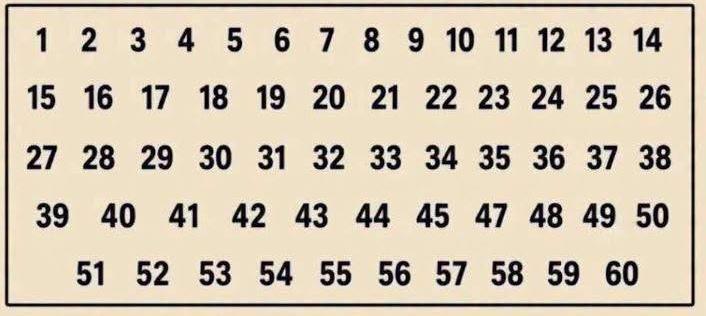

This missing number puzzle asks one tidy question: which whole number has disappeared from a list meant to contain 1 through 60? There is no secret equation to decode. Look at the supplied grid, follow the numbers in order, and find the gap.
Give yourself a moment before scrolling if you want the challenge unspoiled. You do not need a stopwatch, a calculator, or anyone telling you what your age is supposed to allow. This is a just-for-fun observation activity, not a test of intelligence or health.
The answer is confirmed both by the source explanation and by the visible sequence. We will show it clearly below, along with a way to verify it instead of simply accepting a reveal. The original age-related taunt has been removed from the displayed puzzle because it is not a meaningful rule.

The Rules of This Missing Number Puzzle
The numbers are arranged across five rows. Read each row from left to right, then move down to the beginning of the next row. The intended set is the whole numbers from 1 through 60, with one missing.
That statement matters. It tells you exactly what should be present. You are not being asked to guess a hidden formula from a few terms or invent a clever relationship between unrelated numbers. You are checking a list against a known sequence.
If you prefer to solve first, pause here. Move through the grid at a comfortable pace and notice whether each number is followed by the next one. A pencil can help you keep your place without turning the activity into a race.

A Gentle Hint Before the Reveal
Start by checking one row rather than letting your eyes wander over the entire page. When you reach its end, remember the final number and check the first entry on the next line.
If the early rows are complete, do not assume the rest must be. The answer is in the fourth row. That narrows the search without asking you to rely on a trick or an unspoken mathematical rule.
Still want one more hint? Focus on the numbers in the forties. Read them aloud if that feels easier. Hearing the expected next number can make a skipped entry more noticeable than a quick glance across the picture.
The Answer Is 46
The source grid jumps directly from 45 to 47. The number that belongs between them is 46. That is the confirmed answer, not a guess based on the number of spaces in the row.
You can check it with a short section of the intended sequence: 43, 44, 45, 46, 47, 48. Compare that with the same portion of the supplied image. Everything needed to explain the gap is right there.
If you found 46 immediately, nice work. If you needed the hint or the reveal, that is fine too. Missing one entry in a busy-looking list is not a diagnosis, a verdict on your abilities, or a reason to feel embarrassed.

Why This Answer Is Not an Arbitrary Pattern
Some online number riddles show a handful of terms and ask what comes next. Without a stated rule, many different formulas can often fit the same small set. A claimed answer may then be only one possible interpretation.
This challenge is different. It states the complete target set: 1 through 60. Under that rule, 46 is not one creative possibility among several. It is the absent integer between the visible 45 and 47.
The condition is important: the answer is unique for this stated list and this image. If someone changes the grid or removes a different number, they have made a different puzzle. The explanation should always match the picture actually being shown.

A Simple Method That Does Not Depend on Speed
First, establish the starting point. Then read each entry and ask what should follow it. Continue across the row, keeping your position with a finger on the screen edge or a note on paper.
Second, check the row breaks. A gap can hide where your eyes move from the end of one line to the start of another. Do not treat those transitions as places where the sequence resets.
Third, verify any suspected gap. If you think a number is missing, look at its immediate neighbors. Here, the neighboring entries settle the issue quickly. There is no need to add the entire list or calculate a complicated total to explain the answer.
There is another easy cross-check after the reveal: read backward through the small section around the gap. You should expect 48, 47, 46, 45, and 44. In the displayed list, the same missing entry interrupts that direction too. This is not a second rule; it is the same sequence inspected from the other end. You can also write those five numbers beside the screen and compare them one at a time. Choose whichever approach feels comfortable. The aim is a clear explanation, not finding the most elaborate way to reach a simple answer.
Leave the Age Claim Out of the Game
The original presentation includes a claim about people over 40 being unable to solve the puzzle. The source itself says that claim has no scientific basis. It is not a useful standard to repeat as a fact.
People of different ages can enjoy looking for the missing number. How quickly someone notices it in one image does not establish anything broad about their memory, thinking, or future health. Lighting, screen size, distraction, and simple preference can all affect how comfortable a puzzle feels.
Keep the invitation friendly: “Want to try this?” works better than “You should be able to do this.” A small challenge is more enjoyable when nobody has to defend their age before taking part.

Share It Without Spoiling the Fun
If you show the puzzle to a friend, separate the picture from the answer paragraph. Offer the fourth-row hint only if they want it. Some people enjoy a quick reveal; others want time to work through the grid themselves.
Do not change the rules midway by demanding a faster result or introducing a new answer. The challenge is to identify the missing integer, and 46 completes the sequence. Once that is found and checked, the job is done.
You can make a fresh version on paper by writing an ordered list and deliberately skipping one entry. Be sure to check your own version first. Accidentally omitting two numbers would create confusion rather than a fair one-gap challenge.

The Satisfying Part Is Checking for Yourself
A reveal is most useful when it includes a reason. Here, “46” comes with the visible jump that proves it. You do not need to trust a dramatic headline or a mysterious scoring system.
That is the whole pleasure of this missing number puzzle: a clear question, a small search, and an answer you can verify. The next time a similar grid appears, take it row by row and let the actual entries—not the hype around them—guide you.
For an especially clear explanation to a younger player, write 45 and 47 with a space between them and ask which whole number belongs there. Then return to the original grid and point out the same jump. That connects the answer with the stated counting rule without pretending the activity measures school ability. Keep the explanation optional for someone who already understands it. The best reveal lets a reader check the result independently rather than demanding that they accept a bare answer.
Thanks for playing along, whether you spotted 46 at once or enjoyed a helpful hint. This puzzle is for entertainment and general information, not professional advice or any assessment of health, intelligence, or age-related ability. Keep it light, and share the fun kindly.