My Mother Hurt My 6-Year-Old Over a Toy and Screamed “Without My Money You’d Be Homeless” — She Had No Idea Who Had Been Paying Her Bills
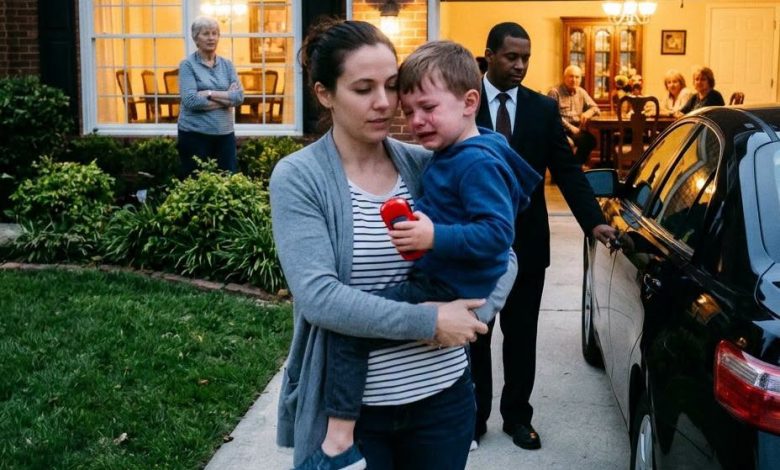
“CLARA! CONTROL THAT SPOILED CHILD!”
My mother’s voice cracked through the dining room like a whip. My six-year-old son, Matthew, was on the floor beside his chair, crying, one hand pressed against the side of his head. There was a red mark near his ear.
My mother had just struck him.
“Mommy,” he sobbed, reaching for me. “I just wanted Daddy’s car.”
Daddy’s Car
The little red toy car had been the last thing my husband, Julian, ever bought for Matthew. Since we lost Julian, our son carried it everywhere. Some nights he slept with it under his pillow.
Earlier that evening, my sister Valerie’s eight-year-old, Dylan, had grabbed it out of Matthew’s hand. Matthew asked for it back. Politely. Twice. When Dylan refused and Matthew reached for it, my mother didn’t correct Dylan.
She punished my son.
Now Valerie was hugging Dylan as if he were the one who’d been hurt. “Your son needs to learn how to share,” she snapped at me.
My father kept eating his roast. Nobody asked if Matthew was okay.
I knelt beside him. “Sweetheart, let me see your ear.” He was shaking.
My mother rolled her eyes. “Stop fussing, Clara. He’s six, not a baby.”
I stood up slowly. “He’s six years old, Mother. You had no right to put your hands on him.”
“Someone has to teach him manners.”
I looked around the table. These were the people I’d spent my whole life trying to please. Not one of them had stood up for my child.
What They Thought They Knew
After Julian died, my family decided I was a helpless widow with a modest office job, barely getting by. My mother loved reminding me how lucky I was to have such a “generous” family. Valerie treated me like an embarrassment. Dad never asked about my work at all.
They knew almost nothing about my real life.
After the funeral, I started a small software company in a rented office the size of a closet. I wrote code through the night while Matthew napped on a blanket under my desk. Six years later, that company was Arcadia Systems, valued at more than seven billion dollars. I was its founder and CEO.
I never told them. I wanted Matthew to grow up around people who loved him, not people who loved his mother’s bank account.
For years, I swallowed the insults. But watching my son cry on that floor ended it.
“Without My Money”
I picked Matthew up. “We’re leaving.”
“Where do you think you’re going?” my mother demanded.
“To get my son checked by a doctor.”
“Don’t be ridiculous. He’s fine.”
Valerie shook her head. “You’re embarrassing everyone over nothing.”
I kept walking. Then my mother shouted the words that stopped me at the door.
“WITHOUT MY MONEY, YOU AND THAT BOY WOULD BE HOMELESS!”
I almost laughed. Because the truth was the exact opposite.
Five years earlier, Dad’s bad investments had nearly cost my parents this very house. I quietly covered the losses through an anonymous investment entity. I’d paid their mortgage, their property taxes, some of their medical bills. And for three years, I’d secretly paid for Dylan’s expensive private school.
They thought they were supporting me. I’d been supporting all of them.
But I didn’t say any of it. Matthew needed me more than they needed the truth.
“My son will never have to accept cruelty just to belong to this family,” I said. And I walked out.
The Second Phone
A black sedan was waiting at the end of the driveway. My driver stepped forward. “Ms. Clara, is everything all right?”
“The hospital, please.”
I buckled Matthew in, then took out my second phone. The one my family had never seen. I called Daniel Mercer, my chief legal counsel.
“Daniel, Matthew’s been hurt. We’re on the way to the hospital. I need you to arrange proper legal protection for him. And I want a full review of every financial arrangement that benefits my relatives. I’m not authorizing another dollar of optional support.”
“Understood. I’ll handle it lawfully. Is he safe?”
“He’s with me.”
Through the window, I could see my family sitting back down to dinner like nothing had happened.
Then, halfway to the hospital, Matthew whispered something from the back seat that made my blood run cold.
“Mommy? Tonight wasn’t the first time.”
What Matthew Told Me
I asked Henry to pull over. I climbed into the back seat next to my son.
Slowly, he told me. When I dropped him off at my parents’ house, Grandma pinched his arm when he was “too loud.” She grabbed him by the wrist when he didn’t move fast enough. She told him that if he complained, the whole family could lose their house, and it would be his fault.
Then he told me about the blue bowl.
Three months earlier, a blue porcelain bowl in my mother’s dining room had broken. She’d called me furious, and I’d paid to replace it just to end the argument. Matthew told me Dylan was the one who broke it. Grandma had seen it happen. She told Matthew to say he did it. When he refused, she shut him in the dark laundry room until he stopped crying.
I held my son and promised him he would never go back to that house.
The Hospital
Dr. Patel, the pediatrician on duty, cleaned the small wound near Matthew’s ear and ordered extra checks to make sure there was no serious injury. There wasn’t. But when Matthew repeated what he’d told me in the car, she did exactly what she was required to do. She reported it to child protection services.
That night, a social worker gently interviewed Matthew with a stuffed bear in his lap. A police officer took my statement in the hallway.
The Money Stops
Daniel worked through every arrangement: the anonymous investment entity covering Dad’s losses, the mortgage, the property taxes, the medical bills, Dylan’s tuition. Some agreements required advance notice before they could be ended, so it took a few weeks. But one by one, the notices went out.
My Mother
She called the next morning demanding that I withdraw my police statement. Then she called complaining about lawyer fees. Then about the “missing” mortgage payment.
On the last call, I reminded her of something. When I was nine, I spilled juice on Valerie’s party dress by accident. She made me stand in the garage for two hours. “You told me that day that actions have consequences,” I said. “Now it’s your turn to learn it.”
Eventually, she accepted a plea agreement: a suspended sentence, mandatory anger management classes, and a court order banning any unsupervised contact with Matthew. I have never arranged a visit.
My Father
A week later, my father showed up at the gates of my estate, demanding to be let in. I spoke to him through the intercom. I told him who had been paying his mortgage, his taxes, and his medical bills for five years.
He didn’t say anything after that. He just stood there, and then he drove away.
Investigators later recovered footage from my parents’ own home security cameras. When they showed it to my father, he admitted he’d seen my mother treat Matthew harshly more than once and never said a word.
Six months later, a handwritten letter arrived. He wrote that his silence had allowed it to happen, and that he’d have to live with that. I kept the letter. I haven’t answered it.
Valerie
My sister came to Arcadia’s headquarters without an appointment. When the receptionist said “Ms. Clara will see you now” and led her to the top floor, I watched her understand, for the first time, who I really was.
I showed her the records. Every tuition payment for Dylan. Every check to our parents.
She sat quietly for a long time. Then she admitted she’d known Mom always protected Dylan and blamed Matthew. She just never thought it mattered.
“It mattered to him,” I said. I told her Matthew wouldn’t be visiting any of them. Dylan transferred to public school after the tuition ended.
The Safe Line
Matthew started seeing a pediatric trauma therapist. In one of their first sessions, he drew a picture: me, him, our house, and a big sun on one side. Grandma, Grandpa, Aunt Valerie, and Dylan on the other. In between, he drew a thick black line.
“That’s the safe line,” he told her. “They stay over there.”
Month by month, he changed. He laughed more. He slept through the night. He stopped flinching when the phone rang.
Seven
On Matthew’s seventh birthday, we watched the sunset on the Pacific coast, the little red car parked in the sand between us.
“Mommy, will Grandma come to my birthdays someday?”
“Only if you can be completely safe,” I said. “That’s the only rule.”
He thought about it. Then he grinned. “Are we billionaire rich?”
I laughed. “We are. But that doesn’t mean we stop saying thank you for things.”
He leaned against my shoulder and watched the sun slide into the water. For years, I had protected my family’s pride. That night, I knew I’d finally protected the only thing that mattered.
This story is a work of fiction. Names, characters, businesses, and events are products of the author’s imagination. Any resemblance to real people, businesses, or events is purely coincidental.