An old cowboy entered a church
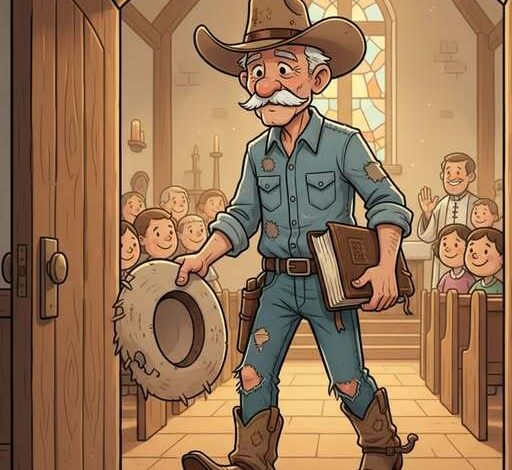
One quiet Sunday morning, just before church services were about to begin, an old cowboy walked through the front doors of a large church. At first glance, there was nothing dirty or careless about him. His clothes were clean, neatly buttoned, and clearly well cared for. Still, they told a different story. He wore faded jeans, a denim shirt that had seen better days, and boots so worn they looked as though they had crossed countless miles of dust and gravel. In one hand, he carried a weathered cowboy hat. In the other, an old Bible, its pages softened by years of use.
The church itself was located in one of the most upscale neighborhoods in the city. It was massive, elegant, and beautifully designed, with polished floors, tall ceilings, and stained-glass windows that caught the morning light. It was, without question, the most impressive church the old cowboy had ever seen.
As he walked down the aisle and found an empty seat, something subtle but unmistakable happened. The people sitting nearby shifted uncomfortably. One by one, they moved away from him, creating a quiet bubble of space. No one smiled. No one offered a greeting. No one welcomed him. Their expressions made their thoughts clear. They were offended by his appearance and made no effort to hide their discomfort.
The service went on as usual, but the cowboy remained invisible to everyone except himself. When it ended, he stood up, placed his hat back on his head, and quietly made his way toward the exit.
Just before he reached the door, the preacher stopped him.
“Sir,” the preacher said politely, though firmly, “I’d like to ask you a favor. Before you come back here again, I want you to talk with God. Ask Him what He thinks would be appropriate attire for worship.”
The old cowboy nodded calmly. “Yes, sir,” he replied. “I’ll do that.”
The following Sunday, the cowboy returned.
He wore the same faded jeans. The same denim shirt. The same worn boots. The same old hat. Once again, the congregation responded with cold silence and visible disapproval. And once again, after the service, the preacher approached him.
“I thought I asked you to speak with God about what you should wear before coming back to our church,” the preacher said.
“I did,” the cowboy answered.
The preacher raised an eyebrow. “And what did God tell you?”
The old cowboy paused for a moment before replying.
“Well, sir,” he said simply, “God told me He didn’t have a clue what I should wear… because He said He’d never been in this church.”
In another church, this time an Anglican one, tradition played a central role in every service. Each gathering began with a familiar exchange. The clergyman would raise his voice and say, “The Lord be with you.”
For many years, the congregation responded in unison, “And with thy spirit.”
Eventually, modern changes were introduced to the liturgy. The greeting remained the same, but the response was updated. Now, when the minister said, “The Lord be with you,” the congregation replied, “And also with you.”
One Sunday, a visiting bishop came to lead the service. The church’s sound system, however, was old and unreliable, something everyone knew well. As the bishop stepped up to the microphone, he tapped it once. Then again. He leaned closer and frowned.
“There’s something wrong with this,” he said aloud.
Without missing a beat, the entire congregation responded automatically and confidently, “And also with you.”
In the southern United States, many churches are known as “answer-back” churches. In these congregations, participation is expected. When the preacher speaks, the people respond loudly and enthusiastically.
One Sunday, a preacher stood before his congregation, delivering a sermon about growth and transformation. He wanted the church to improve, to move forward, and to become something greater.
“If this church is to become better,” he declared, “it must take up its bed and walk.”
The congregation shouted back, “Let it walk, Preacher! Let it walk!”
Encouraged by their response, the preacher continued. “If this church is going to become better, it will have to throw aside its hindrances and run!”
The people replied even louder, “Let it run, Preacher! Let it run!”
Now fully energized, the preacher raised his voice. “If this church truly wants to become great, it will have to take up its wings and fly!”
The congregation roared, “Let it fly, Preacher! Let it fly!”
Then the preacher delivered his final line.
“If this church is going to fly,” he said, “it’s going to cost money!”
The room fell silent for just a moment before the congregation answered in unison, “Let it walk, Preacher… let it walk.”
These stories, though humorous, quietly reveal truths about human nature—about judgment, habit, and how easily sincerity can be replaced by routine or appearances. Sometimes, laughter is the most effective mirror.
Disclaimer: All stories published on this website are for entertainment and storytelling purposes only. They do not have an identified author and are not claimed to be based on real events or people. Any resemblance to actual persons or events is purely coincidental.