An Unexpected Moment at the Store That Changed My Perspective
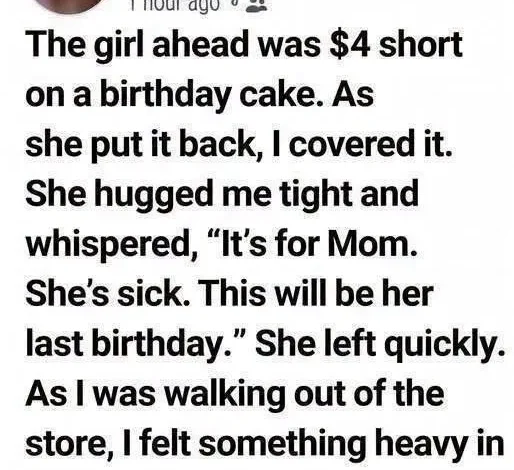

This is a work of fiction inspired by a short story shared online. Names, characters, and events are made up.
Most people move through life too fast to notice what’s happening right next to them. I know, because for most of my forty-one years, I was the queen of moving too fast. I had a phone in one hand, a list in the other, and a cat at home who had opinions about my schedule.
Then one rainy Tuesday afternoon, a little girl at a supermarket checkout put a cake back on the counter, and my whole life slowed down in the best possible way.
Let me tell you what happened.
And let me warn you now: it involves four dollars, a crayon drawing, a very judgmental cat, a pie-baking neighbor, and a coincidence so big I still get goosebumps thinking about it.
Chapter 1: The Worst Tuesday
My name is Nora Bennett. I’m a freelance bookkeeper, which means I spend my days making other people’s numbers behave while my own life does whatever it wants.
That Tuesday started with Biscuit, my orange tabby, deciding that the cereal box on the counter had personally insulted him. I watched him put one paw on it, look me dead in the eye, and push. Little oat circles went everywhere. Into the toaster. Under the fridge. Into my left slipper, which I discovered a moment later.
“Really?” I said.
Biscuit blinked slowly, the way cats do when they want you to know they’d do it again.

I had three client reports due by Friday, a dentist appointment I’d already rescheduled twice, and a grocery list so long it had a second page.
My phone buzzed with a message from my client Gary, who ran a small landscaping company and wrote every email in capital letters.
“NORA. WHERE IS MARCH.”
March, Gary, was in a shoebox of crumpled receipts you dropped on my porch last week. But I didn’t type that. I typed, “Working on it! Will send soon,” with a smiley face I did not feel.
I swept the cereal into a pile, shoved the list between my teeth so I could hold my coffee and my phone at the same time, and promised myself I’d be at the store by two. I got there at four-fifteen.
Fairlane Market is a small, family-run grocery store about six blocks from my apartment. It has squeaky carts, a bakery case that smells like heaven, and a cashier named Denise who has worked there for as long as anyone can remember.
Denise calls everyone “sugar” and knows exactly which aisle the cinnamon has moved to this week.
By the time I’d filled my basket, my feet hurt, my umbrella was dripping on my shoes, and I was mentally rewriting Gary’s March in my head. I got in line behind a little girl, and honestly, at first I barely noticed her.
Chapter 2: The Girl With the Coin Jar
She was maybe eight years old. She had a long brown ponytail, a pink jacket a size too small, and a backpack with a strap held together by a safety pin. On the counter in front of her was a single item: a small white bakery box with a clear window on top. Inside, I could see a round vanilla cake with white frosting and a little piped border.
And next to it was a glass jar.
The kind you’d keep pickles in, cleaned out, with a strip of masking tape on the lid.
“That’s eighteen ninety-nine, sweetheart,” Denise said gently.
The girl nodded like she’d been expecting that exact number. She unscrewed the jar and tipped it over. Out came a little waterfall of coins: pennies, nickels, dimes, a few quarters, and three crumpled dollar bills that had clearly been folded and unfolded many times.

She counted. Out loud, in a whisper, sliding each coin into little stacks with one finger. Denise waited patiently, which is one of the things I love about her. The man behind me sighed loudly. I gave him a look I’d learned from Biscuit.
“Fourteen… sixty-three,” the girl finally said. She counted it again to be sure.
“Fourteen sixty-three.”
Denise’s face went soft. “Oh, honey. You’re a little short.”
I waited for the girl to argue, or cry, or ask if there was a cheaper cake. She didn’t do any of those things. She just nodded, very quietly, the way a grown-up nods when they get bad news they were already braced for.
Then she gently slid the cake box back across the counter toward Denise.
“Thank you,” she whispered.
That was it. That’s the moment that got me. Not the coins. Not the safety pin. It was the “thank you.” She thanked the cashier for telling her she couldn’t have the thing she came for. She said it like she’d had a lot of practice.
Something inside my chest went tight. I wasn’t thinking about Gary anymore.
I wasn’t thinking about my feet or my dentist or my oat-filled slipper.
Chapter 3: Four Dollars and Thirty-Six Cents
I’m not usually a jump-in kind of person. I’m a “think about it for three days and then make a spreadsheet” kind of person. But before my brain could make a single column, my hand was already reaching past the girl with my debit card.
“I’ve got the rest,” I said to Denise.
Denise looked at me over her glasses, and I swear her eyes got a little shiny. “You sure, sugar?”
“Completely sure.”
The girl turned around and stared up at me. She had big gray eyes, the serious kind that make you feel like you’re being studied by a tiny professor.
“You don’t have to,” she said.
“I know,” I said. “I want to.”
Denise rang it up.
Fourteen sixty-three in coins, and four dollars and thirty-six cents on my card. I’ve paid more for a sandwich I didn’t even like. I’ve spent four dollars on a fancy coffee that tasted like burnt toffee. This was the best four dollars and thirty-six cents I’d ever spent, and I knew it before the receipt even printed.
The girl carefully scooped her coins back into her jar, even though they now belonged to the store. Denise laughed and said, “Leave those, honey, I’ll take care of it.” The girl insisted on stacking them neatly first. Every single one.
Then, without warning, she threw her arms around my waist and squeezed. Hard. Her little face pressed against my wet coat, and she held on like she was afraid I’d disappear.

“It’s for my mom,” she said into my coat. “She’s not feeling well.”
I didn’t know what to say. I patted her back awkwardly, the way people do when they don’t have kids and suddenly have one attached to them.
“Then you’d better get it home to her,” I managed. “Happy birthday to your mom.”
She let go, picked up the cake box with both hands like it was made of glass, and walked toward the sliding doors. She didn’t run. She walked very carefully, holding that cake level the whole way. At the door she turned around, gave me one small wave, and then she was gone into the rain.
The man behind me cleared his throat. “Could we, uh, move this along?”
Denise didn’t even look at him. “Sir, you can wait thirty seconds for a miracle,” she said, and started scanning my groceries.
Chapter 4: The Note in My Pocket
I walked home under my dripping umbrella with two heavy bags and a strange, warm feeling. I kept replaying the “thank you.” I kept seeing that safety pin.
When I got home, Biscuit greeted me at the door by sitting on my foot, which is his way of saying “Where have you been, servant?”
I put the groceries away, fed him his fancy salmon dinner as an apology for the morning, and hung my coat on the hook by the door.
That’s when I heard it. A little crinkle.
I reached into my right coat pocket, expecting a receipt or a gum wrapper. Instead, my fingers found a small square of paper, folded over and over until it was the size of a postage stamp.
I unfolded it at the kitchen table. It was a piece of lined notebook paper, torn neatly along the side. In big, wobbly pencil letters, it said:
Thank you for helping me. I didn’t know what to do.
And underneath the words was a drawing in pink and yellow crayon. A round birthday cake, with frosting dripping down the sides.
And on top, one single candle with a bright little flame and lines around it to show it was glowing.

I sat there for a long time.
She must have slipped it into my pocket during the hug. But here’s the part that really got to me: the paper had been folded many, many times. The creases were soft and fuzzy. The pencil was a little smudged from being carried around. She hadn’t written this in the store. She’d written it before she ever left home.
This little girl had walked to the store with fourteen dollars and sixty-three cents, knowing the cake might cost more. And just in case someone helped her, she’d already prepared a thank-you note.
She hadn’t expected kindness.
But she’d hoped for it so hard that she got ready for it anyway.
I made a cup of chamomile tea and sat under the kitchen lamp with the note in my hands. Biscuit hopped up onto the chair next to me, curled into a cinnamon bun shape, and fell asleep, purring like a tiny motor.

One question kept nagging at me. One candle.
Why one candle? A mom wouldn’t be turning one. Maybe the girl just didn’t have room to draw thirty-something candles. That’s what any sensible person would assume. But I’m a bookkeeper. Numbers that don’t add up bother me. And that one little candle didn’t add up.
Chapter 5: Detective Nora
The next morning, I sent Gary his March. All of it. Every receipt sorted, every number in its place. He replied, “THANK YOU NORA YOU ARE A WIZARD,” which is the nicest thing Gary has ever written to anyone in capital letters.
Then I did something I’d never done before. I walked back to Fairlane Market for no reason at all. No list. No basket. Just a question.
Denise was at her register, ringing up a man buying nine cans of soup and one balloon. When she saw me, she grinned.
“Well, if it isn’t my hero from yesterday,” she said.
“I’m not a hero,” I said. “I paid four dollars.”
“Four dollars and thirty-six cents,” she corrected. “I remember. Rang it up myself.”
I waited until the soup man left, then leaned on the counter. “Denise, the little girl. Do you know her?”
Denise’s face changed a little. Not closed up, exactly. More careful. She’s the kind of person who protects her regulars.
“Why do you ask, sugar?”
I showed her the note.
She read it, and then she pressed her hand to her heart and said, “Oh, that child.”
“I’m not trying to be nosy,” I said. “I just… I keep thinking about her. And her mom. She said her mom wasn’t feeling well. I wondered if there was anything I could do. Maybe drop off some groceries, or flowers, or something.”
Denise thought about it for a long moment. Then she nodded slowly.
“Her name’s Lily. She comes in with her grandpa, Walt, most Saturdays. He volunteers at the community garden over on Pine Street. Nice man. Wears suspenders every day of his life.” She lowered her voice. “Her mama’s been through a lot this past while. I’ll let Walt tell you the rest, if he wants to. He’s at the garden most mornings around ten.”
“Thank you, Denise.”
“Don’t thank me,” she said, waving me off.
“Go do something good. And buy a donut on your way out. You look like you skipped breakfast.”
I had. Biscuit had eaten my toast. That’s a whole other story.
Chapter 6: Grandpa Walt and the Tomatoes
The Pine Street Community Garden is a patch of land squeezed between a laundromat and a church parking lot, and in late October it’s glorious. The leaves were turning gold and orange, the last of the tomatoes were hanging on stubbornly, and someone had planted a row of sunflowers that stood taller than me.
I spotted Walt right away. Denise wasn’t kidding about the suspenders. He was a big, broad-shouldered man in his seventies with a gray beard and a flat cap, kneeling next to a tomato plant. And next to him, holding a dented metal watering can that was almost as big as she was, was Lily.

She saw me first. Her mouth fell open. Then she dropped the watering can, which splashed all over Walt’s boots, and came running down the path.
“It’s the cake lady!” she shouted. “Grandpa! It’s the cake lady!”
Walt stood up slowly, brushing dirt off his knees, and squinted at me. Then a huge smile spread across his face.
“So you’re the famous one,” he said, walking over and shaking my hand with a grip like a friendly bear. “Lily hasn’t stopped talking about you. You’ve been described to me as ‘nice, with a brown coat and wet hair.’”
“That’s accurate,” I said, laughing.
“I’m Walt Harper. And this one you’ve met.”
“Did my mom like the cake?” I asked Lily, then caught myself. “I mean, did your mom like the cake?”
Lily giggled at my mistake. “She cried,” she said, very matter-of-fact. “But the good kind of crying. Grandpa says there are two kinds.”
Walt put a hand on her head. “Lily, how about you go water the sunflowers?
They look thirsty.”
She ran off with the can. Walt and I sat on a wooden bench at the edge of the garden, and for a minute he didn’t say anything. He just watched his granddaughter giving each sunflower a careful drink, talking to them like they were old friends.
“I owe you four dollars and thirty-six cents,” he finally said.
“You don’t owe me anything.”
“I know. But I wanted to say it anyway.” He sighed. “I offered to buy that cake, you know. Three times. She wouldn’t let me. She said it had to be from her money, because a present isn’t a real present if somebody else pays for it. She’s been saving since March. Every coin she found in the couch. Every dollar from the tooth fairy.
She even sold lemonade on the sidewalk in August and gave half of it to the animal shelter, because, and I quote, ‘the dogs need birthdays too.’”
I laughed and wiped my eyes at the same time. “She sounds amazing.”
“She is. She’s the best thing that ever happened to this family.” He was quiet for a second. “Can I tell you about her mom?”
“Only if you want to.”
He nodded. “My daughter’s name is Rachel. She’s a nurse. Has been for fifteen years. Hospice and palliative care, mostly. The hardest kind of nursing there is, if you ask me. Taking care of folks at the very end.” He shook his head with pride. “She was always the one holding everybody’s hand.”
Something in the back of my mind flickered. I didn’t know why yet.
“About three years ago,” Walt went on, “her kidneys started failing.
Some condition she’d had since she was young finally caught up with her. She was on dialysis for a long time. Three times a week, four hours at a time. She kept working as long as she could, but eventually she couldn’t. Lily was only five when it started.”
“I’m so sorry.”
“Don’t be sorry yet. This part’s the good part.” He smiled. “One year ago this week, Rachel got a kidney transplant. A donor family said yes on the worst day of their lives, and because of them, my daughter got a second chance.”
I felt the pieces clicking into place.
“One year,” I said slowly. “One candle.”
Walt looked at me, surprised. “Lily told you about the candle?”
I pulled the note out of my pocket and showed him.
He held it for a long time, and his big hands were shaking a little.
“That’s her new birthday,” he said quietly. “That’s what Lily calls it. Rachel’s real birthday is in June, but Lily decided the transplant day was her mom’s ‘new birthday,’ the day she got to start over. So this year, Rachel is turning one.” He laughed through his nose. “Lily insisted on exactly one candle. I tried to tell her we could do a few more for decoration. You’d have thought I suggested canceling Christmas.”
“And she’s not feeling well?” I asked gently.
“Rough couple of weeks,” Walt said. “An infection. Nothing she can’t beat, the doctors say. Transplant patients take medicine that keeps their body from rejecting the new kidney, but it also makes it easier to catch things. She’s home now, resting, getting stronger.
But it scared Lily. That’s why the cake mattered so much. She wanted her mom to have a happy day.”
We sat for a while and watched Lily tell a sunflower a long story about a dog named Pancake.
“Would you like to meet Rachel?” Walt asked. “She’s been asking about you. Wants to thank you herself. Sunday afternoon, we’re doing a little party at the house. Just family. Well. Family and whoever Lily invites, which this week seems to be you, the mailman, and a squirrel.”
“I’d love to,” I said. And I meant it more than I’d meant anything in a long time.
Chapter 7: The Snowstorm I Never Talk About
That night, I couldn’t stop thinking about something Walt had said. Hospice and palliative care. She was always the one holding everybody’s hand.
I hadn’t told Walt this, but six years ago, my dad died in hospice.
His name was Frank Bennett, and he was the funniest man I’ve ever known. He was a retired mail carrier who whistled old songs badly and told the worst penguin jokes you’ve ever heard. “Why don’t penguins fly, Nora? Because they’re not tall enough to be pilots.” Every single time, he’d laugh so hard at his own joke that you couldn’t help laughing too, even though it was terrible.
He got sick quickly. Too quickly. One minute he was complaining about my driving, and a few months later he was in a hospice center two hours north of here, closer to where my aunt lived.
I visited every weekend. But on the night he passed, there was a snowstorm. A real one. The highway closed.
I sat in my car on the side of the road for three hours, snow piling up on my windshield, calling the hospice over and over.
A nurse answered. I never got her last name. She had a calm, warm voice, and she said, “Nora, I’m right here with him. I’m holding his hand. Would you like me to put the phone by his ear so he can hear you?”
So I talked to my dad from a frozen car on the side of a highway. I told him I loved him. I told him I was sorry I wasn’t there. And then, because I didn’t know what else to say, I told him one of his own terrible penguin jokes.
The nurse told me later that he smiled.

He passed about an hour later, peacefully, with that nurse still holding his hand.
When the roads opened, I drove up to collect his things.
The nurse wasn’t on shift. The front desk told me her name was Rachel, and I wrote her a long thank-you card at the kitchen table that night. I meant to mail it. But I didn’t know her last name, and a few months later I heard the hospice had merged with a bigger hospital network and the staff had scattered. I kept telling myself I’d track her down.
I never did. The card is still in my desk drawer, in its envelope, with just one word on the front: Rachel.
I got up at two in the morning, opened the drawer, and took it out. Biscuit watched me from the bed with deep suspicion.
“It’s probably not her,” I told him. “There are a million nurses named Rachel.”
Biscuit yawned, as if to say, “Then why are you holding the envelope, genius?”
Chapter 8: Yellow Tulips
On Sunday, I put on my good sweater, my brown coat, and the bravest face I could find. I stopped by Fairlane Market for a bouquet of yellow tulips, because yellow felt right for a new birthday.
Denise wrapped them for me and refused to let me pay.
“Consider it my four dollars and thirty-six cents,” she said, winking.
The Harpers lived in a small blue house with white trim on a quiet street full of crunchy leaves. There was a hand-painted sign taped to the door. In very careful purple marker, it said “HAPPY NEW BIRTHDAY MOM,” with the N backward.
I knocked. The tulips were shaking a little in my hand.
The door opened, and there was Rachel.

She was thin and a little pale, wrapped in a long, oversized cardigan, with her hair pulled up in a messy bun. But her smile was enormous, and her eyes were the same serious gray as her daughter’s.
Lily peeked out from behind her, grinning like she’d personally arranged the whole thing.
“You must be Nora,” Rachel said. “The cake lady.”
And I froze.
Because I knew that voice.
I’d heard it only once, six years ago, through a crackly phone line in a freezing car on the side of a highway. But you don’t forget a voice that tells you, “I’m right here with him. I’m holding his hand.”
“Are you okay?” Rachel asked, tilting her head.
“I’m sorry,” I said. “This is going to sound strange. Did you ever work at Pinecrest Hospice? Up near Millbrook?”
Rachel’s eyebrows went up. “For six years. Why?”
My throat closed up. I tried to say it calmly, but it came out as a whisper. “Frank Bennett. Do you remember a patient named Frank Bennett? Six years ago, during a snowstorm?”
Rachel stared at me.
Then she put a hand over her mouth.
“The penguin man,” she said softly. “Oh my goodness. The penguin jokes. He told me one every single shift. ‘Why don’t penguins fly?’”
“Because they’re not tall enough to be pilots,” I said, and then I started crying right there on her porch, holding yellow tulips, in front of an eight-year-old and a confused mail carrier walking by.
Rachel stepped out, cardigan and all, and hugged me. A long, real hug. The kind her daughter gives.
“You were in the car,” she said into my shoulder. “In the snow. You told him the joke on the phone.”
“You held his hand for me.”
“He smiled when he heard you,” she said. “I’ve never forgotten that. I’ve told that story to new nurses for years.
About the daughter who couldn’t get there but still made her dad laugh.”
Lily looked back and forth between us with her mouth open. “Wait. You already know each other?”
Walt appeared in the doorway behind them, holding a spatula and looking baffled. “What did I miss?”
“Grandpa,” Lily announced, “this is the biggest coincidence in the history of the universe.”
For once, I didn’t think an eight-year-old was exaggerating.
Chapter 9: A Party for One Candle
The Harpers’ living room was small and cozy and absolutely covered in paper streamers. Lily had clearly been in charge of decorations. There were streamers on the lamp, streamers on the bookshelf, and one streamer tied, for reasons nobody explained, around the leg of the coffee table.
The party guests were exactly as Walt had promised: family, plus whoever Lily had invited.
That turned out to be me, the Harpers’ next-door neighbor Mr. Okafor, and Mrs. Lindqvist from across the street, who used to be Lily’s preschool teacher and laughed at everything.
Mr. Okafor was a tall, retired music teacher with a booming voice and the gentlest hands I’ve ever seen. He arrived holding a pecan pie like it was an award.
“I heard there was a cake,” he said. “But a party with only one dessert is not a party. It’s a meeting.”
Lily clapped. “Mr. Okafor makes the best pie in the whole state.”
“The whole country,” he corrected, very seriously. “But I’m humble, so I let people say state.”
Walt grilled burgers in the backyard with the spatula he’d been waving around at the door.
Rachel sat on the couch with a blanket over her knees, because she still tired easily, and every few minutes Lily brought her something: a glass of lemonade, a pillow, a drawing, a very small rock she’d found that looked “exactly like a potato.”
At one point, while Lily was showing Mrs. Lindqvist her rock collection, Rachel patted the couch next to her. I sat down.
“I’ve thought about you over the years, you know,” she said quietly. “Not by name. Just as ‘the daughter in the snow.’ I always hoped you were okay.”
I reached into my bag and pulled out the envelope. It was a little wrinkled and a little faded, with her name on the front in my handwriting from six years ago.
“I wrote this the night he died,” I said. “I never knew how to find you.
I’ve carried it from my old apartment to my new one, and it’s lived in my desk drawer ever since. I think it’s finally time it got delivered.”
Rachel took it carefully, with both hands. Exactly the way Lily had held the cake.
She opened it and read it. I won’t share everything I wrote, because some things belong only to the person they’re written for. But I’ll tell you the last line, because I remembered it word for word: “I couldn’t be there to hold his hand, so thank you for holding it for me. I hope someone is always there to hold yours.”
Rachel folded the card and held it against her chest for a while. “Someone was,” she said finally, looking across the room at her dad and her daughter. “Someone always was.”
Then she laughed and wiped her eyes on her cardigan sleeve.
“Okay. That’s enough crying on my new birthday. Where is my one candle?”
Lily gasped like she’d almost forgotten the most important part of the day. She ran to the kitchen and came back with the cake. The cake. The very same vanilla cake with white frosting that she’d carried home in the rain, one careful step at a time.
In the very center, standing straight and proud, was one single candle.
Walt lit it. Mr. Okafor, being a retired music teacher, insisted on leading the birthday song in three-part harmony, which nobody else could follow, so it sounded a bit like a choir of friendly geese. Mrs. Lindqvist laughed so hard she had to sit down. Lily sang the loudest. I sang too, and I didn’t care that my voice cracked.

“Make a wish, Mom,” Lily said.
Rachel closed her eyes for a long moment. Then she blew out the candle in one breath. Everyone cheered.
“What did you wish for?” Lily demanded.
“If I tell you, it won’t come true,” Rachel said.
“That’s not a real rule,” Lily said. “Grandpa made that up.”
“Your grandpa did not make that up,” Walt called from the doorway. “That rule is very old. Older than me, even.”
“Nothing is older than you, Grandpa.”
Walt pretended to be deeply wounded and clutched his heart, and Lily giggled until she got the hiccups.
The cake was, I have to say, delicious. Not because it was fancy. It was a simple grocery store vanilla cake. But it was the best cake I’ve ever tasted, because I knew exactly how many couch-cushion coins and tooth fairy dollars and lemonade-stand quarters had gone into it. And four dollars and thirty-six cents from a tired bookkeeper who almost didn’t look up from her phone.
Mr.
Okafor’s pie was also delicious. I told him it was the best in the country. He looked very pleased.
Chapter 10: The Thing About Small Gestures
Later, as the sun went down and the streamers drooped and Mr. Okafor taught Lily how to play “Heart and Soul” on a tiny toy keyboard, Rachel and I sat on the porch steps wrapped in blankets.
“Can I ask you something?” I said. “The note. Lily wrote it before she even got to the store. Did you know?”
Rachel smiled. “Not until afterward. She told me she wrote it the night before. She said she was pretty sure she didn’t have enough money, because she’d seen the price on the sign when she went with Grandpa. But she said, ‘Mom, if somebody helps me, I want to be ready to say thank you properly.’”
I shook my head.
“Who teaches an eight-year-old that?”
Rachel was quiet for a while. “I think she learned it from all the people who helped us,” she said. “When I was on dialysis, people showed up. Neighbors brought casseroles. Mrs. Lindqvist picked Lily up from school for months. Mr. Okafor shoveled our driveway every single snowstorm without being asked. And the donor family. We’ll never know their names, but they gave me this.” She tapped her side gently. “Lily has watched people be kind to us for three years. I think she just wanted to be ready to say thank you when it happened again.”
“It’s funny,” I said. “I thought I was helping her. But I think she helped me more.”
“That’s usually how it goes,” Rachel said. “I learned that in hospice. You think you’re the one giving comfort.
But the people you care for end up teaching you everything about how to live.” She bumped my shoulder with hers. “Your dad taught me that you can find a joke in almost any room, no matter how sad it is. I’ve told about a thousand penguin jokes since then.”
“Oh no,” I said. “He’d be so proud.”
“He’d be unbearable,” she agreed, and we both laughed until Biscuit-level snorts came out of me, which I’m not proud of.
Epilogue: What I Keep in My Coat Pocket Now
That was a year ago.
A lot has changed since then. Rachel is doing well. She went back to nursing part-time this fall, working with a transplant support program, helping patients who are waiting for the same second chance she got. Her doctors are happy with how she’s doing, and she says she has more energy than she’s had in years.
She walks Lily to school most mornings now, which Lily says is “the best part of every single day.”
Walt still wears suspenders. He has convinced me to rent a plot at the community garden, where I grow tomatoes that are, frankly, embarrassing. He says they “have character.” Mr. Okafor has started giving me piano lessons on Thursday evenings in exchange for doing his taxes. I am terrible at piano. He says I have character, too.
Lily is nine now. She still saves coins in a glass jar. Last month she used them to buy a bag of dog treats for the animal shelter, because, of course, the dogs need birthdays too.
And as for me, I’ve changed in small ways that add up. I look up from my phone in line now. I notice people. I listen more than I rush. Gary still emails me in all capital letters, but I’ve stopped minding.
Last week he wrote, “NORA YOU ARE THE BEST,” and I printed it out and stuck it on my fridge next to Lily’s crayon cake.
Oh, and one more thing.
Every morning, before I head out, I tuck a few folded dollar bills into the right pocket of my brown coat. Not a lot. Just enough. Four dollars and thirty-six cents, give or take. It’s my “just in case” money. Just in case someone ahead of me in line is a little short. Just in case someone needs to know that a stranger noticed them.

I’ve used it four times so far. A teenager buying school supplies. An older man buying a birthday card for his wife. A tired mom with a crying toddler who was a dollar short for diapers.
A college student who forgot his wallet and was trying to buy a sandwich.
None of them knew why I did it. I didn’t explain. I just smiled and said, “Pay it forward when you can.”
And every time, I think about a little girl in a pink jacket with a safety-pinned backpack, standing at a checkout counter, saying “thank you” for news she didn’t want to hear. I think about a crayon cake with one candle. I think about a nurse in the snow, holding a stranger’s hand. And I think about my dad, who would absolutely tell me, if he were here, that the whole story is proof that the world is smaller and kinder than we think.
Then he’d tell me a penguin joke.
So here’s one for you, Dad. Why did the penguin cross the road?
To go with the floe.
I know. It’s terrible. He’d love it.
What This Story Reminds Us
We never truly know what someone else is carrying. The little girl in line might be saving for months. The tired person behind you might be heading home from a hospital. The cashier might be the one who notices everyone when no one notices her.
Kindness doesn’t have to be big to matter. It can be four dollars. It can be a hug. It can be a note in a coat pocket, or a hand held during a hard night. Small gestures have a way of traveling far, often much farther than we ever get to see.

Thank you so much for spending this time with Nora, Lily, and the whole Harper crew! This is a work of fiction written for entertainment, and any resemblance to real people or events is purely coincidental, but we hope it nudges you to look up from your phone the next time you’re in line.