My Daughter Charged Me $340 for Doctor Rides—Then I Revealed Who Really Owned Her SUV
**PART 3**
She laughed nervously and looked at Robert.
“She’s kidding, right? This is some kind of joke about the gas money.”
Robert didn’t answer.
I could tell he already understood.
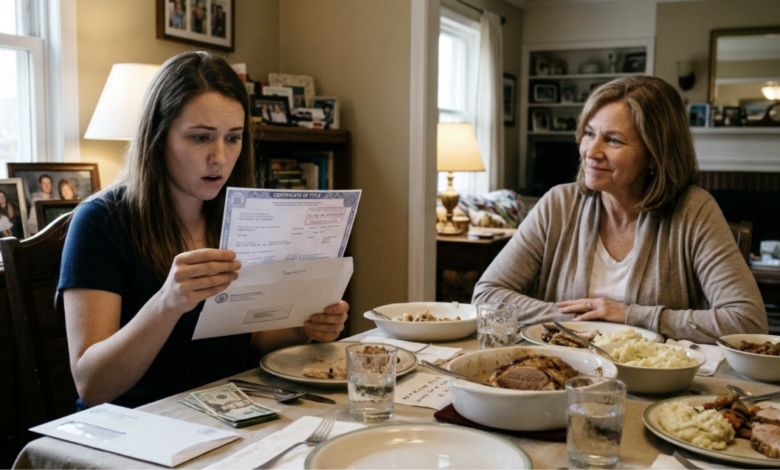
Jillian pushed the title toward me.
“Okay, seriously. What is this?”
“It’s the title. My name is on it. I made the last payment in October. I have the right to decide what happens to the vehicle.”
“You’re taking my car?”
I looked at her.
“Your car?”
She said it so quickly, so naturally, that I almost smiled.
“That’s what you called it?”
“Mama, I’ve been driving it for three years!”
“I know. I’ve been paying for it for three years.”
“You said it was for me!”
“I said I bought it so you could get to work. I never said I was giving you ownership.”
She opened her mouth, then closed it.
Her cheeks began turning red.
“Are you seriously doing this because of three hundred and forty dollars?”
“No.”
“Then what is it?”
I glanced at the yellow legal pad sitting beside my plate. The numbers were still there. Seventeen trips. Twenty dollars each.
“It’s because of the way you looked at me when you handed me that bill.”
“Mama, I was just trying to be fair!”
“Fair?”
I let that word sit between us.
“Jillian, you know how many years I drove that school bus? Twenty-six years. I drove children through snowstorms, rain, freezing mornings, and roads so slick I couldn’t see the ditches. I never once asked a mother to pay me extra because her child needed to be dropped off somewhere.”
“That’s different!”
“Why?”
“Because you’re their bus driver!”
“And I was their bus driver. I was also a mother. I was also a woman who understood that sometimes people need a little help.”
She rolled her eyes.
“Mama, you’re making this into something it isn’t.”
“No, sweetheart. I’m finally calling it what it is.”
Robert cleared his throat.
“Jill, maybe you should just let her finish.”
She turned on him.
“Don’t start.”
He looked down at his plate.
I watched the two of them, and for the first time in a long while, I didn’t feel the need to rescue my daughter from the uncomfortable silence she’d created.
I didn’t rush to explain.
I didn’t apologize.
I didn’t tell her that I loved her so much that I’d spent nights worrying about whether she’d make it to work when she was going through her divorce.
I didn’t tell her that when I signed the papers for that SUV, I had been terrified of losing the little money I had saved for emergencies.
I didn’t remind her that I’d taken money out of my own savings to cover the down payment because the dealership wouldn’t approve her.
I didn’t tell her that I’d skipped replacing my kitchen floor because I wanted her to have a reliable car.
She knew all of that.
Or at least, she used to.
“Mama,” she said, her voice now quieter, “you can’t just take it away from me.”
“I can.”
“How am I supposed to get to work?”
I looked at her, and something in me softened. Not enough to change my decision, but enough to remember the little girl who used to climb into my lap after school and tell me about the things that had happened on the playground.
“That’s a question you should have asked before you decided I was a customer.”
She looked away.
Robert finally spoke.
“Edith, I think Jillian’s upset. Maybe we could talk about this another day.”
I nodded.
“We can talk about it another day. But the car isn’t changing ownership.”
Jillian stood so suddenly that her chair scraped the floor.
“This is unbelievable.”
She grabbed her purse and shoved the title back into the envelope.
“You know what? Keep your stupid car. I don’t need it.”
I didn’t say anything.
She turned toward the door.
Then she stopped.
“You’re going to regret this.”
I looked at her.
“Maybe. But I don’t think I’ll regret asking you to treat me like your mother instead of your bank account.”
She walked out.
Robert followed her, but before he stepped outside, he turned around.
“I’m sorry, Edith.”
I nodded.
“Eat the pie before you go. I made it for everybody.”
He looked like he wanted to say something else, but Jillian was calling his name from the driveway.
He left.
The door closed.
Mitchell was still sitting at the table.
He looked at the envelope, then at me.
“Grandma, are you okay?”
I smiled.
“Actually, sweetheart, I think I am.”
But I wasn’t entirely sure.
Because when the house went quiet, I could hear my own heart beating, and I wondered whether I’d just made the biggest mistake of my life.
Not because of the car.
Because of my daughter.
I had spent so many years believing that if I gave enough, loved enough, forgave enough, and stayed quiet enough, eventually my children would understand what a mother was worth.
That evening, I went to bed early.
I didn’t sleep.
At 2:17 in the morning, my phone rang.
It was Jillian.
I answered.
“Mama, I need to talk to you.”
Her voice was different. Not angry exactly. Something closer to panic.
“What is it, honey?”
“I can’t believe you’re actually doing this.”
I sat up.
“Jillian, it’s two in the morning.”
“I know, but Robert says we might have to refinance the house if we can’t get another car.”
I closed my eyes.
“That’s not my decision, sweetheart.”
“You could just transfer the title! You know I need the car!”
“Then we’ll talk about your options in the morning.”
She started crying.
And for one terrible second, I felt the old instinct rise inside me.
The instinct to say, Don’t cry, honey. Mama will fix it.
But I swallowed those words.
“Jillian, I love you. We’ll talk tomorrow.”
Then I hung up.
I lay back against the pillow.
The ceiling was dark, and the little digital clock on my nightstand glowed red.
I thought about the years I’d spent fixing things for her.
The rent she couldn’t pay.
The electric bill she’d forgotten.
The groceries I’d bought when she was short.
The school clothes for Mitchell.
The Christmas presents I put on my credit card because she was embarrassed to tell her son she couldn’t afford them.
I had always believed those things were part of being a mother.
And they were.
But somewhere along the way, I’d begun to confuse love with being available for every emergency, every inconvenience, every bill, every disappointment.
And I had forgotten something important.
I was a person, too.
At six the next morning, I made coffee and sat by the window.
The sun was coming up over the neighbor’s garage.
My phone rang again.
This time it was Mitchell.
“Grandma, can I come over?”
“Of course.”
“Can we talk?”
“Sure, sweetheart.”
He came over around eight, carrying a paper bag from the bakery.
He set it on the table.
“I got you cinnamon rolls.”
I laughed.
“Well, now you’re trying to buy your way into the will.”
He grinned.
“Maybe.”
Then he sat down.
“Grandma, I think you should know something.”
I looked at him.
“What is it?”
He hesitated.
“Mom’s been telling people you promised her the car.”
I felt my stomach tighten.
“Who has she been telling?”
“Uncle David. Aunt Lisa. Some people at church.”
I stared at my coffee.
“She told them I promised her the car?”
“She said you gave it to her when she got divorced. She said you told her it was hers, and now you’re taking it back because she’s trying to help you.”
I didn’t say anything.
Mitchell continued.
“She told Aunt Lisa you were confused about the title because you can’t see very well anymore.”
The room seemed to get colder.
“She said that?”
“Yeah.”
I looked out the window.
A school bus was turning at the corner.
For twenty-six years, I had watched those buses come and go.
I knew how children waved through the windows.
I knew how parents stood in their driveways waiting.
I knew what it meant to trust someone with your family.
And now my own daughter was telling people that my eyes made me incapable of understanding my own decisions.
“Grandma?”
I turned.
Mitchell was watching me.
“Do you want me to say something to her?”
“No.”
“Because I can.”
I shook my head.
“No, sweetheart. Let her say what she wants. The truth doesn’t need you to fight every battle.”
But I knew then that this wasn’t going to end with a car title.
It was going to end with something much bigger.
And I had a feeling Jillian had no idea what was coming.
Because on Monday morning, I had an appointment at the credit union.
And this time, I wasn’t going there to make a payment.
I was going to ask them a question I’d never thought I’d have to ask in my entire life.
How do I protect what belongs to me from the people I love?
**PART 4**
Monday morning, I put on my blue cardigan, the one with the little pearl buttons, and asked Mitchell to take me to the credit union.
He didn’t ask why.
He just grabbed his keys, opened the passenger door of his pickup, and helped me climb in.
“Grandma, you want me to go inside with you?”
“Not yet, sweetheart. Let me talk to them first.”
The credit union sat on the corner of Main Street, right beside the pharmacy where I’d filled prescriptions for twenty years. I knew the woman behind the counter. Her name was Denise. She’d helped me set up my pension deposits and explained more than once how to avoid those little fees banks like to sneak into accounts.
When she saw me walk in, she smiled.
“Edith! How are your eyes doing?”
“Still giving me trouble, but I’m managing.”
She walked around the counter and guided me to a chair.
“How can I help you today?”
I took the folder out of my purse.
“I need to know how to protect myself.”
Her smile faded a little.
“From what?”
I took a breath.
“My daughter.”
Denise didn’t look shocked. She didn’t ask me what happened. She simply pulled her chair closer.
“Okay. Tell me what you’re concerned about.”
I told her about the car. The gas money. The way Jillian had handed me the bill in the parking lot. The Sunday dinner. The title. The phone call at two in the morning.
And then I told her about what Mitchell had heard.
When I finished, Denise folded her hands.
“Edith, first of all, your name is on the vehicle title. The loan is paid off. That means the vehicle is yours. You have every right to decide what to do with it.”
“I know. But I don’t want to hurt her.”
“I understand. But you also don’t want someone making financial decisions for you without your permission.”
She explained that I could cancel any automatic payments I had set up, review my accounts, make sure nobody had access to them, and update my emergency contact information.
She also recommended that I speak with an attorney about estate planning and a durable power of attorney.
I nodded slowly.
“Do you think I’m being cruel?”
Denise looked at me for a long moment.
“Edith, being generous doesn’t mean you have to be unprotected.”
That sentence stayed with me.
I asked her to print my account records for the past year.
Then I sat there and went through them with my magnifier.
There were small withdrawals I didn’t recognize immediately.
A $78 charge from a home improvement store.
A $46 online purchase.
A $112 charge at a department store.
I rubbed my eyes.
“Denise, what are these?”
She leaned closer.
“These are debit card transactions.”
I remembered giving Jillian my card once.
It was the winter before last. I had been sick, and she’d offered to pick up groceries. I gave her my card and told her to buy whatever I needed.
I’d never thought about it again.
But when I looked at the dates, I recognized some of them.
The home improvement store was the day Jillian had told me she’d picked up a new shower curtain for my bathroom.
The department store was the week before Mitchell’s birthday.
I didn’t know whether every charge was wrong. Some might have been mine. I wasn’t going to accuse anyone based on a few numbers I couldn’t fully recognize.
But I knew I needed to ask.
“Can I get a new card?” I said.
“Of course.”
“And can we make sure nobody else has permission to access my accounts?”
Denise nodded.
We went through everything.
By the time I left, I had a new debit card, new passwords, and a printed statement tucked into my folder.
Mitchell was waiting in the truck.
“How’d it go, Grandma?”
“Good.”
“Did you do what you needed to do?”
“I did.”
He smiled.
“Then let’s get you a cinnamon roll.”
We stopped at the bakery.
I bought two.
One for him.
One for me.
For the first time in weeks, I felt like I was doing something for myself without having to justify it to anybody.
**The Phone Calls Started That Afternoon**
By three o’clock, my phone had rung six times.
Jillian.
Aunt Lisa.
My brother David.
Then Jillian again.
I didn’t answer.
At four, a text came through.
Mama, what are you telling people?
I stared at it for a moment.
I hadn’t told anybody anything.
Then another message.
Lisa says you went to the bank and changed everything. Are you serious?
I put the phone down.
Five minutes later, it rang.
This time I answered.
“Hello.”
“Mama, what did you do?”
“Hello to you too, Jillian.”
“Did you remove me from your accounts?”
“I reviewed my accounts.”
“Why?”
“Because I wanted to.”
She let out a sharp breath.
“You’re making me sound like some kind of thief.”
“I haven’t called you anything.”
“Then why are you changing passwords?”
“Because I have the right to.”
There was silence.
Then she said something that made my hands tighten around the phone.
“You know I was only helping you.”
“Helping me with what?”
“Your bills! Your appointments! Everything!”
I looked at the calendar on my refrigerator.
There were seventeen appointments marked in blue.
Every one of them was a retina injection.
“Jillian, I appreciate the rides you’ve given me.”
“Then why are you acting like I did something wrong?”
“Because you handed me a bill.”
“It’s not unreasonable to ask for gas money!”
“No. It isn’t.”
She seemed surprised by that.
I continued.
“If you had told me you needed help with gas, we could have talked about it. If you’d said you couldn’t drive me anymore, I could have found another way. But you wrote down seventeen trips and handed me a bill like I was a stranger who’d hired you.”
“Mama, you’re twisting everything!”
“No, honey. I’m telling you how it felt.”
Her voice rose.
“Do you know how much time I spend taking you places?”
“I do.”
“Do you know how inconvenient it is?”
I closed my eyes.
There it was.
The word she’d never said before.
Inconvenient.
I was inconvenient.
My appointments were inconvenient.
My failing eyesight was inconvenient.
My need for help was inconvenient.
“Jillian,” I said quietly, “I won’t ask you to drive me anymore.”
She stopped.
“What?”
“I’ll find another arrangement.”
“You can’t just do that!”
“I can.”
“You’re going to make Mitchell do everything?”
“No. I won’t make anybody do anything.”
She started crying, but the tears sounded angry.
“You’re punishing me.”
“No, sweetheart. I’m making a decision.”
Then she hung up.
I sat there for a long time.
I wanted to cry.
Not because I was losing the rides.
Because I was losing the feeling that my daughter would be there when I needed her.
I thought about the little girl who used to run into my kitchen with scraped knees.
I thought about her first day of school.
Her wedding dress.
Her divorce.
The way she’d held my hand at the hospital when my husband died.
I had spent my life believing that love could survive anything.
And I still believed it.
But I was learning that love sometimes needed a boundary to survive.
**The Sunday Dinner That Never Happened**
The following Sunday, I made no pot roast.
I didn’t set the table for four.
I made myself a bowl of soup and sat near the window.
At 12:30, Mitchell arrived.
He brought a loaf of bread and a small bouquet of yellow flowers.
“Grandma, I figured you might not want to cook.”
I smiled.
“You know me too well.”
He set the flowers in a glass jar.
Then he sat down.
“Mom’s telling everybody you kicked her out of your life.”
I sighed.
“Did she?”
“She says you’re refusing to let her drive the car, that you canceled her access to your money, and that you won’t let her help you anymore.”
I stirred my soup.
“That’s not what happened.”
“I know.”
He looked at me carefully.
“Grandma, I don’t think she understands how much you did for her.”
I looked at him.
“Maybe I never made her understand.”
“You shouldn’t have to.”
I reached across the table and took his hand.
“Sweetheart, there’s something I want you to remember. You don’t owe me rides. You don’t owe me groceries. You don’t owe me money. I love you because you’re my grandson, not because you help me.”
He smiled, but his eyes were a little wet.
“I know, Grandma.”
“And if you ever have to say no to me, I won’t stop loving you.”
He squeezed my hand.
“I know that, too.”
We ate our soup.
Then he helped me put the dishes away.
Before he left, he asked if he could look at my SUV.
“Grandma, the tires are getting worn. I can check them.”
“All right.”
He crouched beside the front tire and inspected it.
“These need replacing soon.”
I laughed.
“Well, that’s another expense I didn’t plan on.”
He stood up.
“Don’t worry. I’ll help you get some quotes.”
I shook my head.
“You can help me look. I will pay for them.”
He gave me a funny look.
“Grandma, I wasn’t asking you for money.”
“I know. But I’m paying because it’s my car, and I want to.”
He smiled.
“Fair enough.”
That was the difference.
He offered help without making me feel like a burden.
And I accepted without feeling like I had to buy his love.
**The Letter From Jillian**
Three days later, I found a letter in my mailbox.
It wasn’t an envelope from the credit union.
It was from Jillian.
Her handwriting was all over the front, pressed so hard into the paper that I could feel the grooves beneath my fingertips.
I sat at the kitchen table and opened it.
Mama,
I don’t understand why you are doing this to me. I have always been there for you. I took you to your doctor when nobody else would. I drove you seventeen times, and I never complained to your face.
I stopped reading.
I took a breath.
Then I continued.
You have no idea how much it costs me to take time off work. I have a family, bills, and responsibilities. I thought you understood that.
Now you’re making me feel like I did something terrible. I never stole from you. I never tried to hurt you. I was just asking for a little help.
I don’t know why you suddenly think I’m a bad daughter.
You made me feel like I was helping you, and now you’re making me feel like I owe you something.
I read that sentence twice.
Then I put the letter down.
I wasn’t angry.
I was sad.
Because Jillian was still trying to turn the whole thing around.
She wasn’t asking why I’d felt hurt.
She was asking why I wouldn’t make her feel better about it.
I folded the letter and put it in the drawer beside my sewing machine.
I didn’t respond.
That evening, I called a transportation service the doctor had recommended.
They offered rides for older patients who needed help getting to medical appointments.
The woman on the phone was kind.
She explained the costs, the scheduling, and how far in advance I needed to book.
I wrote everything down.
My eyesight made the numbers difficult, but I took my time.
For the first time, I arranged my own ride.
It cost me money.
But I didn’t feel guilty.
I didn’t have to wonder whether the driver was sighing at every red light.
I didn’t have to feel like I was taking up too much of somebody’s day.
I could simply be a patient going to her appointment.
And that was enough.
**Part 4: The Envelope She Never Expected**
The following Tuesday, I had my retina appointment.
The transportation service sent a woman named Carol. She was about sixty, with silver hair, a cheerful voice, and a little clipboard she carried everywhere.
“Mrs. Edith? I’m Carol. I’ll be taking you to your appointment today.”
She helped me into the vehicle and made sure my seat belt was comfortable.
“Have you been coming to this clinic long?”
“About two years.”
“That’s a lot of visits.”
“It is.”
She didn’t sigh.
She didn’t check her phone every thirty seconds.
She didn’t make me feel like I was costing her something.
When we arrived, she walked me to the entrance and waited until I was safely inside.
“Just call me when you’re done, and I’ll be right here.”
I almost cried.
Not because she’d done anything extraordinary.
Because she hadn’t made me feel like I was a problem.
After my appointment, I sat in the waiting room and thought about how strange it was that I’d spent so much of my life believing I had to earn kindness by being useful.
I’d been a mother.
A wife.
A grandmother.
A school bus driver.
A neighbor who brought casseroles when somebody was sick.
A woman who watched other people’s children when their parents worked late.
I had always been proud of being dependable.
But I hadn’t realized how often I’d allowed people to confuse my willingness to help with an obligation to keep helping.
I was still learning.
And at seventy-two years old, I was learning that it was perfectly acceptable to say no.
**Jillian Came to My House Without Calling**
On Thursday afternoon, somebody knocked on my front door.
I was sitting in my living room sewing a pillowcase. The light was good, and I’d finally gotten the thread through the needle without using my magnifier.
I heard three sharp knocks.
Then another three.
“Mama! Open the door!”
I recognized Jillian immediately.
I set the sewing down and walked carefully to the door.
When I opened it, she was standing on my porch with her arms crossed.
“Why haven’t you answered my calls?”
“I was sewing.”
“You’ve been ignoring me.”
“I’ve been busy.”
She looked past me into the house.
“Can I come in?”
“Of course.”
She walked straight into the kitchen, dropped her purse on the counter, and sat down.
I followed her.
“What would you like, honey? Coffee?”
“No.”
“Tea?”
“No, Mama.”
I sat opposite her.
She looked tired.
Her hair was pulled back, and there were dark circles under her eyes.
“Robert and I have been arguing.”
“I’m sorry to hear that.”
“It’s because of the car.”
I didn’t say anything.
She continued.
“He thinks I should just apologize to you and stop making this worse.”
I folded my hands.
“That sounds like sensible advice.”
She looked at me sharply.
“Mama, don’t.”
“Don’t what?”
“Don’t act like you’re some innocent person here.”
I looked at her.
“I haven’t said I’m innocent. I’ve said I don’t want to argue.”
She leaned forward.
“You know what the worst part is? Everybody thinks I’m a terrible daughter now.”
“Who is everybody?”
“Aunt Lisa. David. Mitchell. People at church.”
“Jillian, I haven’t told anyone you were a terrible daughter.”
“Well, they know about the car!”
I shook my head.
“Mitchell told me what you said about me.”
She froze.
“What?”
“He told me you said I was confused about the title because of my eyesight.”
Her face changed.
“I never said that.”
“Mitchell heard it.”
“He misunderstood.”
I didn’t raise my voice.
“Then tell him the truth.”
She stared at me.
For a moment, I thought she might apologize.
Instead, she stood up.
“You know what? This is exactly what I mean. You’re using your eyesight against me. You’re making people feel sorry for you.”
I felt a small ache in my chest.
Not physical.
Something deeper.
“Jillian, I have never asked anybody to feel sorry for me.”
“Well, you sure act like it!”
She picked up her purse.
Then she stopped near the door.
“Mama, I need the car.”
I looked at her.
“Why?”
“Because mine is unreliable.”
“You have a car?”
She hesitated.
“It’s an old one.”
“Then perhaps you should repair it.”
“I don’t have the money!”
I sat quietly.
She stared at me, waiting.
Waiting for the words she’d heard all her life.
I’ll take care of it.
Don’t worry.
Mama will help.
But I didn’t say them.
Finally, she whispered, “You really aren’t going to give it to me?”
“No.”
She shook her head.
“I can’t believe you.”
Then she walked out.
The door closed so hard the little bell hanging above it rattled.
I stood there for a moment.
Then I went back to my sewing.
I finished the pillowcase.
And for the first time, I didn’t feel like I needed to call her to make sure she was okay.
**The Truth About the Seventeen Trips**
That Saturday, Mitchell came over to help me replace a lightbulb in the hallway.
He was studying for an electrical certification test and had been explaining to me how different types of wiring worked.
I didn’t understand half of it, but I enjoyed listening.
When he finished, he sat down at the kitchen table.
“Grandma, Mom told me she wants to talk to you.”
“Does she?”
“She says she’s ready to apologize.”
I put the kettle on.
“That’s good.”
He looked at me.
“But I don’t think she’s really sorry.”
I sat down.
“Why do you say that?”
“Because she keeps saying the only thing she did wrong was asking for gas money.”
I sighed.
“Mitchell, I don’t expect her to agree with everything I say.”
“But Grandma, that’s not the point.”
He looked down at his hands.
“I remember when you bought her that SUV. I was there.”
I smiled.
“You were seventeen.”
“I remember you taking me to the dealership after school. Mom was crying because nobody would approve her for a loan. You told her you’d help.”
“Yes.”
“You paid the down payment. Then you made the monthly payments.”
“Yes.”
He shook his head.
“Grandma, you didn’t just buy her a car. You gave her a chance to start over.”
I looked at him.
“That’s what mothers do sometimes.”
“Yeah. But she acts like you owe her now.”
I didn’t answer.
Mitchell reached into his jacket pocket.
“I have something.”
He handed me a folded piece of paper.
“What is this?”
“I wrote down the dates Mom told me about the car.”
I unfolded it.
He’d written:
The day Grandma bought the SUV.
The day Mom told him it was hers.
The day Mom said Grandma was confused about the title.
The day Mom told Aunt Lisa she had been paying for the car herself.
I looked at the last line.
“Mitchell, why did you write this?”
“Because I think Mom is telling different stories to different people.”
I folded the paper carefully.
“Sweetheart, I don’t want you in the middle of this.”
“I’m not trying to be in the middle.”
“I know.”
“But Grandma, I think there’s something else you should know.”
I looked at him.
“What?”
He hesitated.
“Mom told Robert that if you didn’t give her the car, she was going to ask somebody to help her get it anyway.”
My hands went still.
“Who?”
“She said she was going to talk to Uncle David.”
I stared at the paper.
My brother David was a good man, but he had a habit of believing the person who talked the loudest.
I wasn’t worried about the title.
I was worried about what Jillian might do next.
**A Visit From My Brother**
David came to my house the next afternoon.
He didn’t call first.
He walked in with a grocery bag and a look on his face that told me he’d already decided what the conversation was going to be about.
“Edith, we need to talk.”
I set the dish towel down.
“About what?”
“Jillian.”
I sighed.
“Of course.”
He sat at the table.
“She’s having a hard time.”
“I know.”
“Her car is breaking down. Robert’s hours have been cut. They’re struggling.”
I nodded.
“That sounds difficult.”
He leaned forward.
“Edith, you know how families are. Sometimes we have to help each other.”
I looked at him.
“David, I’ve helped her.”
“Well, help her again.”
I didn’t answer.
He looked around the kitchen.
“That SUV is just sitting there. Why don’t you let her keep it?”
I almost laughed.
It was the same sentence I’d heard from Jillian.
The same words.
The same assumption.
The car wasn’t sitting there.
I used it when I needed groceries, when I went to the pharmacy, and when I had appointments that didn’t require the retina clinic.
But I wasn’t going to explain all of that.
“David, the car belongs to me.”
“Nobody’s disputing that.”
“Then why are you asking me to give it away?”
He rubbed his forehead.
“Because she’s your daughter.”
I looked out the window.
A bird was sitting on the fence.
“David, do you remember when Mom used to say that if you give somebody everything, eventually they stop seeing it as a gift?”
He shrugged.
“Maybe.”
“She was right.”
He sighed.
“Edith, don’t make this bigger than it is.”
I looked at him.
“I didn’t make it bigger. I asked for twenty dollars a trip, and she handed me a bill.”
He shook his head.
“That’s not what she told me.”
“What did she tell you?”
“She said you were angry because she asked for gas money.”
I nodded.
“Then she left out the part where she called me inconvenient.”
David looked uncomfortable.
“She didn’t say that to me.”
“She said it to me.”
He sat quietly for a moment.
Then he said something I hadn’t expected.
“Edith, maybe you should just let the car go. You’re not getting younger. You don’t need the trouble.”
I stared at him.
And suddenly I understood.
This wasn’t just about Jillian.
It was about how everybody had gotten used to me being the one who gave things up.
My time.
My money.
My comfort.
My peace.
My belongings.
My own choices.
I had become the person who was supposed to make everybody else’s life easier.
And when I finally said no, they all acted as if I had broken some family rule.
I stood up.
“David, I’m going to ask you to leave.”
He looked surprised.
“What?”
“I’m tired. I don’t want to talk about this anymore.”
He stood slowly.
“Fine. But don’t be surprised when things get ugly.”
I looked at him.
“They’re already ugly, David. That’s why I’m trying to stop them.”
He left.
I locked the door.
Then I sat down and cried.
Not loudly.
Not dramatically.
Just the kind of crying that comes when you realize you have spent decades trying to make everybody happy and still somehow ended up disappointing them.
**The Unexpected Knock**
Two days later, I received a call from my attorney.
His name was Mr. Palmer.
I’d spoken with him once before, years ago, when my husband and I made our wills.
“Mrs. Edith, I reviewed the documents you requested.”
“Thank you.”
“There’s something else I think you should consider.”
“What is it?”
“Your daughter appears to believe the vehicle was gifted to her. You should keep the title and the payment records together. If there’s ever a dispute, documentation matters.”
“I have all the payments.”
“Good. Also, I recommend that you make sure your will and financial documents are current.”
I told him I’d come in the following week.
After we hung up, I opened my drawer and took out the old folder where I kept my paperwork.
The title.
The loan statements.
The insurance documents.
The receipts.
Everything was there.
I organized them carefully.
Then I placed the folder in a small locked box in my bedroom.
I wasn’t trying to punish Jillian.
I wasn’t trying to make her life difficult.
I simply didn’t want to spend the rest of my life being afraid of what somebody might say about the things I’d worked for.
That evening, Mitchell called.
“Grandma, Mom’s coming over tomorrow.”
“Did she call you?”
“Yeah. She said she’s going to make things right.”
I looked at the locked box.
“All right.”
“Grandma, do you want me there?”
I thought for a moment.
“No, sweetheart. This is between your mother and me.”
“Okay.”
Then he said something that made my heart ache.
“Grandma, I just want everybody to stop fighting.”
“I know, sweetheart.”
“I miss when Sunday dinners were normal.”
I looked at the empty chair across from me.
“I do, too.”
After we hung up, I went to bed.
But I couldn’t sleep.
Because something about Jillian’s sudden promise to make things right didn’t feel like an apology.
It felt like she was preparing for something.
And the next morning, when I opened my front door, I saw her standing on the porch.
She wasn’t alone.
Robert was beside her.
And in Jillian’s hand was another envelope.
“Mama,” she said, “we need to settle this today.”
I looked at the envelope.
Then I looked at Robert.
He wouldn’t meet my eyes.
And for the first time, I wondered if my daughter had come to apologize…
or if she had brought something that was going to change everything.
\*\*I didn’t know what was inside that envelope.
But I was about to find out why Jillian had suddenly stopped asking for the car—and started demanding something else entirely.\*\*
**THE END**