The Sergeant Ordered an 82-Year-Old Woman to Remove Her Military Pin—Then the General Recognized Her Name
My name is Eleanor Whitcomb. I am eighty-two years old, and I have spent most of my life trying to forget the worst night I ever lived through.
For forty-seven years, I worked as a nurse. I raised two children, buried my husband, and learned how to live alone in a little white house outside Fayetteville, North Carolina.
But before all of that, I was an Army nurse in Vietnam.
And one rainy Thursday afternoon, a young sergeant at Fort Liberty reminded me of something I had almost forgotten.
That the past does not stay buried simply because we stop talking about it.
It began with a bowl of vegetable soup.
I had driven thirty-five minutes to attend a veterans’ luncheon at the installation. My invitation was folded neatly inside my purse, alongside my identification card and a photograph I had carried for more than fifty years.
I was wearing a navy-blue coat, comfortable shoes, and a small silver pin shaped like a lantern.
The pin was old.
The silver had darkened around the edges, and the tiny flame engraved in its center had almost disappeared.
It was the last thing Captain Samuel Mercer gave me before he died.
I was halfway through my soup when someone stopped beside my table.
“Excuse me, Grandma.”
I looked up.
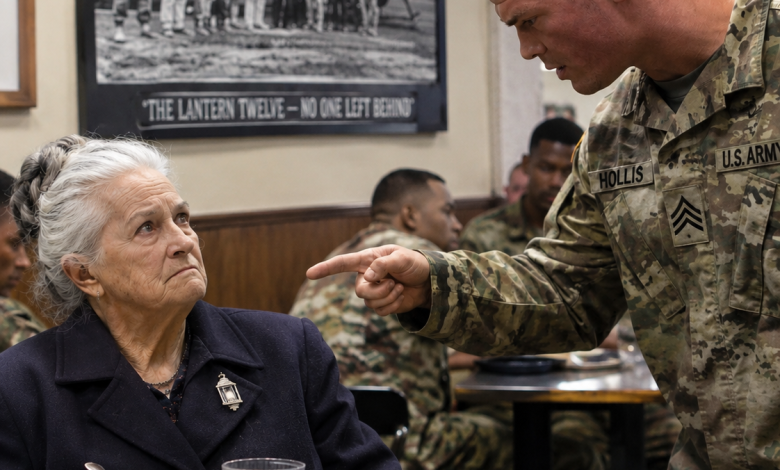
A broad-shouldered staff sergeant stood over me, accompanied by two younger soldiers.
His name tape read HOLLIS.
“You’re sitting in the reserved section,” he said.
I looked around.
There were plenty of empty chairs.
“I was invited,” I replied.
He gave a short laugh.
“Everyone says that.”
One of the soldiers behind him smiled.
The sergeant folded his arms.
“This event is for military personnel and authorized veterans. Not people looking for a free lunch.”
I placed my spoon beside my bowl.
“I understand.”
“Then you understand why I’m asking you to leave.”
I reached toward my purse.
“My invitation is right here.”
But before I could open it, his eyes moved toward my coat.
He noticed the pin.
His expression changed.
“Where did you get that?”
I touched the little silver lantern.
“It was given to me.”
“By whom?”
“Someone I served with.”
He leaned closer.
“That symbol belongs to the Lantern Unit.”
I said nothing.
He pointed toward it.
“That unit has a history. You don’t get to wear its insignia because you found one in an antique store.”
A few nearby conversations stopped.
I could feel people watching.
“Please remove it,” he said.
“No.”
His jaw tightened.
“Ma’am, I’m trying to be respectful.”
“Then start.”
His two companions stopped smiling.
The sergeant straightened.
“I can have you escorted out.”
“You can,” I said. “But first, I’d like you to look at the wall behind you.”
He glanced over his shoulder.
Above the entrance hung a large black-and-white photograph.
It showed twelve medical personnel standing beside a military helicopter.
Underneath were the words:
THE LANTERN TWELVE — NO ONE LEFT BEHIND.
The sergeant turned back toward me.
“What about it?”
I pointed at the photograph.
“Third person from the left.”
He looked again.
A young woman stood in the photograph, wearing a stained medical uniform, her hair tied back beneath a scarf.
The sergeant stared at her.
Then he looked at me.
For the first time, he seemed uncertain.
“That’s you?”
I nodded.
“That was me.”
He looked back at the photograph.
“But the records say only eleven members of that team survived.”
I lowered my eyes.
“Yes,” I said quietly.
“That’s what they were told.”
And that was when the commanding general entered the dining hall.
The Woman in the Photograph
Major General Adrian Cole had come to deliver a short speech at the veterans’ luncheon.
He was sixty-one, with silver hair and a calm manner that made people straighten without being asked.
When he noticed the small crowd around my table, he approached.
“Is there a problem here?”
Sergeant Hollis immediately stood at attention.
“Sir, I was verifying this visitor’s authorization.”
The general looked at me.
Then at the photograph.
Then at my silver lantern.
His expression changed.
“Ma’am,” he said carefully, “what is your name?”
“Eleanor Whitcomb.”
He went completely still.
“Whitcomb?”
“Yes, sir.”
He took one step closer.
“Did you serve with Captain Samuel Mercer?”
My throat tightened.
“I did.”
The general removed his glasses.
For several seconds, he said nothing.
Then he whispered something I had not heard in fifty-four years.
“Little Lantern.”
My hands began trembling.
Only one person had ever called me that.
Samuel Mercer.
“How do you know that name?” I asked.
The general looked toward the photograph.
“Because Samuel Mercer was my father.”
The Night Nobody Wanted to Remember
In November 1971, I was a twenty-eight-year-old Army nurse stationed at a small medical facility in South Vietnam.
We were attached to a helicopter evacuation team unofficially called the Lantern Twelve.
The name came from Captain Mercer.
He carried a battered brass lantern that had belonged to his grandfather. Whenever the generators failed, he would light it and place it near the operating table.
“Nobody gets lost while there’s still a light burning,” he used to say.
There were twelve of us.
Doctors, nurses, medics, and flight crew.
We worked long nights and slept whenever we could.
We treated American soldiers, allied troops, and civilians.
Samuel believed that a wounded person stopped being an enemy the moment they needed help.
Not everyone agreed.
One night, our medical station received word that a nearby village had been struck during fighting.
There were wounded civilians.
Children.
An elderly woman.
A young mother carrying a baby who was barely breathing.
The roads were dangerous, and our commanding officer ordered us to remain at the station.
Samuel argued.
The officer refused.
Samuel asked for volunteers.
All twelve of us stepped forward.
We loaded our supplies into two helicopters and flew into the darkness.
When we landed, the village was burning.
I remember the smell.
Smoke, wet earth, and something metallic that I still cannot describe.
We worked for hours.
Samuel carried a wounded boy to the helicopter himself.
I treated a little girl with a deep cut along her arm.
Her name was Mai.
She was seven years old.
She had a red ribbon in her hair and kept asking whether her mother was coming.
I told her we would find her.
I meant it.
Then the shooting started again.
Our pilots shouted that we had to leave.
The first helicopter lifted off with several wounded people aboard.
The second was almost full.
Samuel was helping an elderly man toward it when an explosion struck nearby.
I was thrown to the ground.
For a moment, I could not hear anything.
When my hearing returned, people were screaming.
Samuel was lying beside the landing area.
I crawled toward him.
His uniform was soaked with blood.
“Eleanor,” he whispered.
I pressed both hands against his wound.
“Don’t talk.”
He tried to smile.
“Still giving orders, Little Lantern?”
“Someone has to.”
He reached into his pocket and pulled out a small silver pin.
A lantern.
He had ordered twelve of them from a jeweler before our deployment.
One for each member of the team.
He pressed his into my hand.
“Keep the light burning,” he said.
I shook my head.
“You’re going to give this to me yourself when we get home.”
But he knew.
I knew too.
He looked toward the helicopter.
“Get the children out.”
“Samuel—”
“Promise me.”
I looked at the little girl waiting near the aircraft.
Mai was holding her injured arm against her chest.
I wanted to stay.
Every part of me wanted to stay.
But Samuel caught my wrist.
“Go.”
I helped Mai aboard.
The helicopter lifted off moments later.
Samuel Mercer died before we reached the medical station.
The Report That Changed Everything
The next morning, military investigators arrived.
They questioned everyone.
Why had we flown without authorization?
Who had ordered the mission?
Why had civilians been evacuated?
I told them the truth.
Samuel had made the decision.
All twelve of us had volunteered.
He had saved lives.
But the officer who had refused permission did not want the unauthorized mission connected to his command.
A report was prepared.
It described the flight as an operational mistake.
It suggested that Samuel had ignored warnings and endangered his team unnecessarily.
I refused to sign it.
Two other nurses refused as well.
A week later, I was transferred.
My official service file contained almost nothing about the rescue.
Samuel’s death was recorded, but the circumstances were reduced to a few cold sentences.
The villagers we had evacuated disappeared from the account entirely.
When I returned home, I tried to challenge the report.
I wrote letters.
I called offices.
I mailed copies of my notes.
Most went unanswered.
One official told me that reopening the matter would only cause pain for the families.
Another suggested that my memories were unreliable because I had been injured during the explosion.
Eventually, I stopped.
I became a civilian nurse.
I married.
I raised children.
But every November, I took out the silver lantern and remembered the people who had been there.
And the man who had died making sure they came home.
The General’s Secret
Back in the dining hall, General Cole pulled out a chair.
“May I sit with you, Mrs. Whitcomb?”
“Of course.”
Sergeant Hollis stood nearby, looking pale.
The general folded his hands.
“My father died when I was seven.”
I nodded.
“I know.”
“My mother told me he was a good man. She said he died helping people.”
“He did.”
“But the official account was different.”
I looked down.
“Yes.”
The general took a breath.
“Three months ago, my mother passed away. While sorting through her belongings, I found a box of letters.”
He opened a leather folder.
Inside were several yellowed envelopes.
I recognized the handwriting immediately.
Samuel’s.
“He wrote to her almost every week,” the general continued. “In his last letter, he mentioned a nurse named Eleanor.”
My eyes filled.
“He said you were the bravest person he had ever met.”
I covered my mouth.
The general slid the letter toward me.
I unfolded it carefully.
The paper was thin and worn.
Near the bottom, Samuel had written:
There’s a young nurse here named Eleanor Whitcomb. She has more courage in her little finger than most men carry in their whole bodies. When things go wrong, she is the one who keeps everyone steady.
I call her Little Lantern.
If anything ever happens to me, I hope someone tells her she made a difference.
I could no longer see the words.
The general waited.
Then he said something that made my heart stop.
“Mrs. Whitcomb, I have spent the last three months looking for you.”
The Missing Witness
General Cole explained that his father’s letters had prompted him to request a review of the historical records.
He had found inconsistencies.
Flight logs did not match the final report.
Medical evacuation numbers were incomplete.
Several witness statements had been excluded from the archived account.
But he needed someone who had been there.
Someone who remembered.
Someone who had kept records.
I reached into my purse.
Behind my invitation was a small brown envelope.
I had carried it with me for decades.
Inside were three photographs, a handwritten patient list, and a carbon copy of my original statement.
The one I had refused to change.
I placed them on the table.
The general stared.
“Where did you get these?”
“I kept copies.”
“All these years?”
“All these years.”
He picked up the patient list.
There were nineteen names.
Nine American service members.
Four allied soldiers.
Six civilians.
At the bottom, in my handwriting, were three words.
All evacuated alive.
The general looked at me.
“This could change the official record.”
I nodded.
“That’s why I brought it.”
He frowned.
“You knew I would be here?”
“I received the luncheon invitation last month. Your name was on it.”
I smiled sadly.
“I thought perhaps Samuel’s son might finally listen.”
The Sergeant’s Apology
Sergeant Hollis had remained standing beside the table.
His face was no longer red.
He looked younger now.
Less certain.
“Ma’am,” he said, “I owe you an apology.”
I looked at him.
“Yes,” I said. “You do.”
He swallowed.
“I shouldn’t have spoken to you that way.”
“No.”
“I shouldn’t have questioned your right to wear that pin.”
“No.”
He looked toward the photograph.
“I didn’t know who you were.”
I studied him.
“Sergeant, that’s the problem.”
He looked confused.
I continued.
“You shouldn’t need to know someone’s history before treating them with respect.”
The room was silent.
“I could have been a visitor who never served a day. I could have been a grandmother waiting for her grandson. I could have been anyone.”
I touched the little lantern.
“None of that would have made your behavior right.”
He lowered his eyes.
“You’re right, ma’am.”
I watched him for a moment.
Then I pointed toward the chair across from me.
“Sit down.”
He hesitated.
“Ma’am?”
“Your lunch is getting cold.”
He sat.
For the next twenty minutes, I told him about Samuel Mercer.
About the village.
About Mai.
About what it means to carry someone else’s life in your hands.
He listened without interrupting.
When I finished, he looked at the pin.
“Would you mind telling me why it’s a lantern?”
I smiled.
“Because sometimes the most important thing a person can do is make sure nobody gets left in the dark.”
The Search for Mai
The investigation took eight months.
Historical researchers examined flight records, medical logs, and the original statements.
Several surviving members of the Lantern Twelve were contacted.
Two confirmed my account.
A third provided a photograph showing civilians boarding the evacuation helicopter.
The evidence was strong enough for the Army to correct its historical account of the mission.
Samuel’s actions were formally recognized.
But one part of the story remained unfinished.
Mai.
The seven-year-old girl with the red ribbon.
I had spent years wondering whether she survived.
She had been evacuated to a hospital, but the records I could access ended there.
I had no idea what happened afterward.
Then, one Tuesday morning, General Cole called me.
“Eleanor,” he said, “are you sitting down?”
I was standing in my kitchen, watering a plant.
“I am now.”
He paused.
“We found her.”
I gripped the phone.
“Mai?”
“Yes.”
I could barely breathe.
“She’s alive?”
“She’s alive. She’s sixty-two years old, and she lives in California.”
I began crying.
The general waited.
Then he said, “And she remembers you.”
The Woman With the Red Ribbon
Mai Nguyen arrived in North Carolina two weeks later.
She was a small woman with silver streaks in her dark hair and a warm smile.
She had become a pediatric physician.
She had two children and four grandchildren.
When she walked into the room, she stopped.
For a moment, we simply looked at each other.
Then she reached into her handbag.
She took out a little red ribbon.
Old.
Faded.
Carefully folded.
“I kept it,” she whispered.
I covered my mouth.
She walked toward me.
“You tied it around my wrist before the helicopter took off.”
I remembered.
Her hair ribbon had fallen loose while I was treating her arm.
I had tied it around her wrist so she would not lose it.
“You told me I was going to be safe,” she said.
“I hoped you would be.”
She shook her head.
“You made me believe it.”
Then she hugged me.
I held her the way I had held her fifty-four years earlier.
Only now she was a grandmother.
And I was an old woman who had finally learned what happened to the little girl she never forgot.
Mai told me that after the evacuation, she had eventually been reunited with her mother.
They had immigrated to the United States years later.
She had studied medicine because she wanted to help frightened children the way someone had once helped her.
“I never knew your name,” she said.
“I knew only that an American nurse saved me.”
I smiled through my tears.
“Her name was Eleanor.”
Mai squeezed my hand.
“I know that now.”
The Ceremony
The recognition ceremony was held the following spring.
General Cole stood before a crowd of soldiers, veterans, and family members.
Behind him was a restored photograph of the Lantern Twelve.
All twelve names were listed beneath it.
Samuel Mercer.
Eleanor Whitcomb.
And ten others who had risked their lives that night.
The corrected historical account described the evacuation and acknowledged the civilians who had been rescued.
Samuel’s son accepted the recognition on his father’s behalf.
When he stepped to the microphone, he looked toward me.
“For most of my life,” he said, “I knew my father through a photograph and a few stories.”
He paused.
“Today, I know him through the people he saved.”
Then he invited me forward.
My knees were not what they used to be.
Sergeant Hollis offered his arm.
I accepted.
He had changed in the months since our first meeting.
He had volunteered to help organize the ceremony.
He had spent weekends interviewing older veterans and recording their memories.
And he had apologized to me again, privately, without an audience.
When we reached the stage, the general handed me a small velvet box.
Inside was a restored silver lantern pin.
On the back were engraved three words:
KEEP THE LIGHT BURNING.
I looked at it for a long time.
Then I shook my head.
“General, may I ask a favor?”
“Anything.”
I turned toward Mai.
She was sitting in the front row beside her children.
“Would you give this to her?”
The general looked surprised.
“Mrs. Whitcomb—”
“Please.”
Mai came forward.
I placed the little lantern in her palm.
“Samuel gave me mine because he believed nobody should be left behind,” I said.
“You’ve spent your life helping children. I think he’d want you to have one too.”
Mai began crying.
She closed her fingers around the pin.
“I’ll keep the light burning,” she whispered.
The Last Bowl of Soup
Six months later, I returned to the dining hall.
It was another Thursday.
Rain tapped against the windows.
I wore my navy-blue coat and my old silver lantern.
The same one Samuel had given me in 1971.
Sergeant Hollis was standing near the entrance.
When he saw me, he smiled.
“Good afternoon, Mrs. Whitcomb.”
“Good afternoon, Sergeant.”
“Vegetable soup today.”
“I know. That’s why I’m here.”
He laughed.
Then he walked beside me toward the serving line.
The photograph of the Lantern Twelve still hung above the entrance.
But the plaque beneath it had changed.
It now included the full story of the evacuation.
All twelve names.
All nineteen people rescued.
And one final sentence:
COURAGE IS NOT THE ABSENCE OF FEAR. IT IS THE REFUSAL TO LEAVE SOMEONE BEHIND.
I stood there for a moment.
Samuel had been gone for more than half a century.
But his name was no longer buried beneath a report that failed to tell the truth.
I touched the silver lantern on my coat.
“Well, Sam,” I whispered, “we finally got everybody home.”
Then I walked to my usual table.
Sergeant Hollis brought over a bowl of soup.
He placed it in front of me.
“Anything else, ma’am?”
I looked at the empty chair across from me.
“Yes,” I said.
“Sit down and tell me about your day.”
He smiled.
And he sat.
For fifty-four years, I had carried the memory of one terrible night.
I had believed that keeping the truth alive meant carrying it alone.
But now I understood something Samuel had known long before I did.
A lantern does not become dimmer when it lights another.
It makes the darkness smaller.
And sometimes, the greatest honor we can give the people we have lost is to make sure their kindness keeps finding its way into the world.
THE END.